
The scenarios, in the app
Every worked scenario can be carried out entirely in the application - the command line is the scriptable surface, not a requirement. Find your scenario below, open the workspace it names, and the numbered steps are on screen in the same order. Generated from the same source as the application's own guided cards, so this page and the software cannot disagree.
Which workspace does my case open?
The full write-up of every scenario - commands, options, limits - stays on the worked scenarios page.
Everyday file loss
Servers, arrays and virtual infrastructure
Recovery bench procedure
Ransomware and incident response
Database files
Mail stores
Evidence and investigation
Sanitisation and disposal
Recover files from disks, cards and images
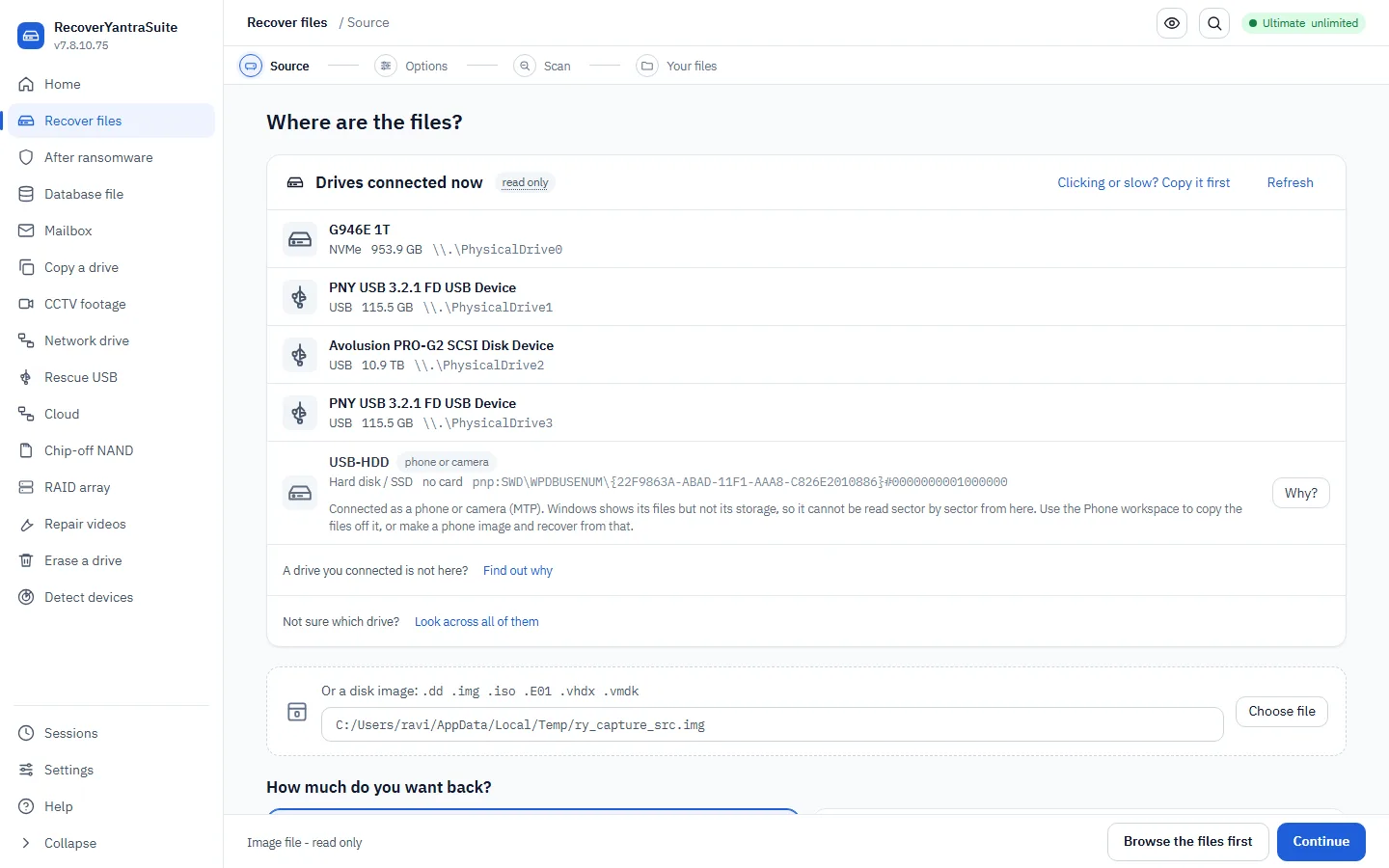
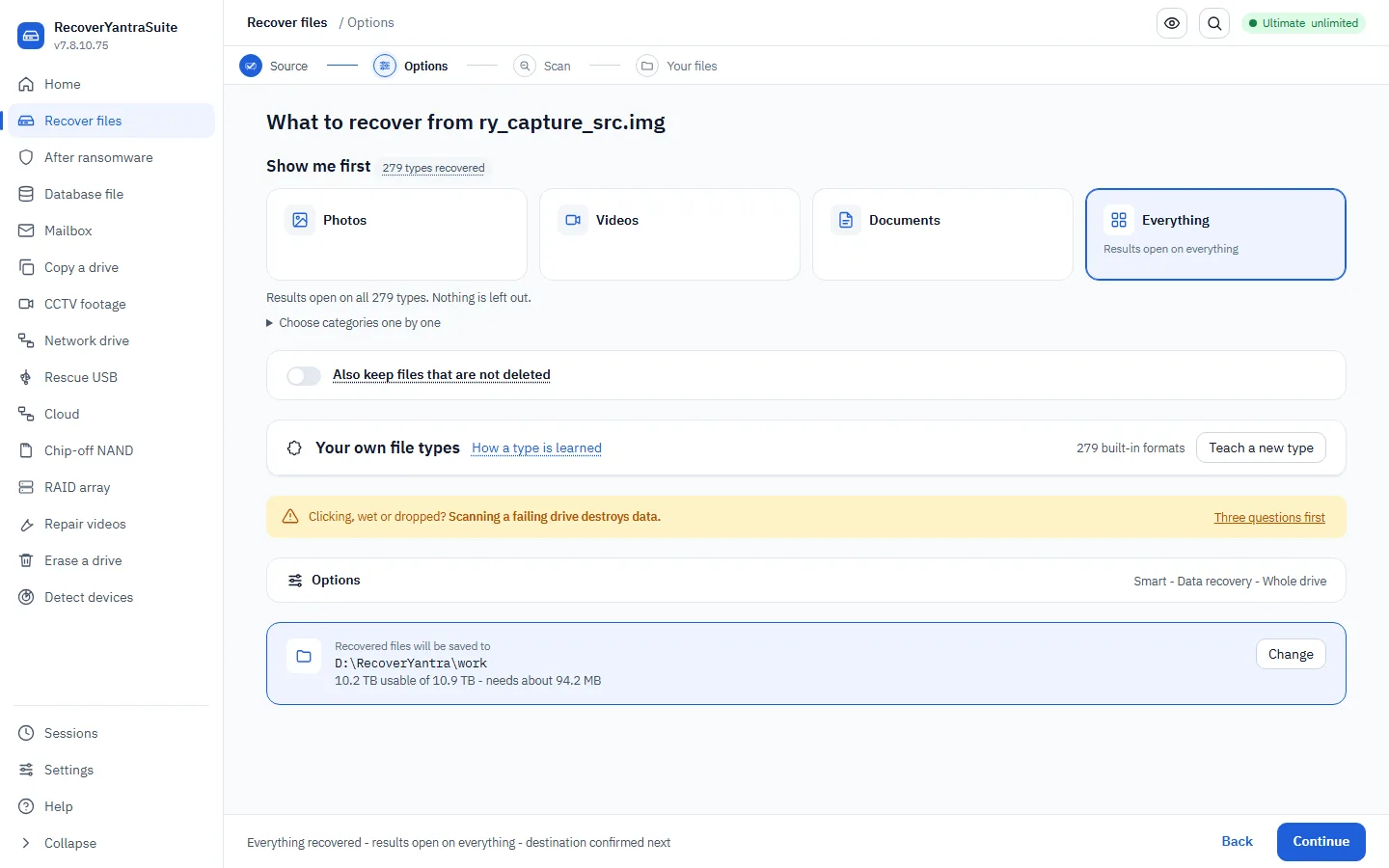
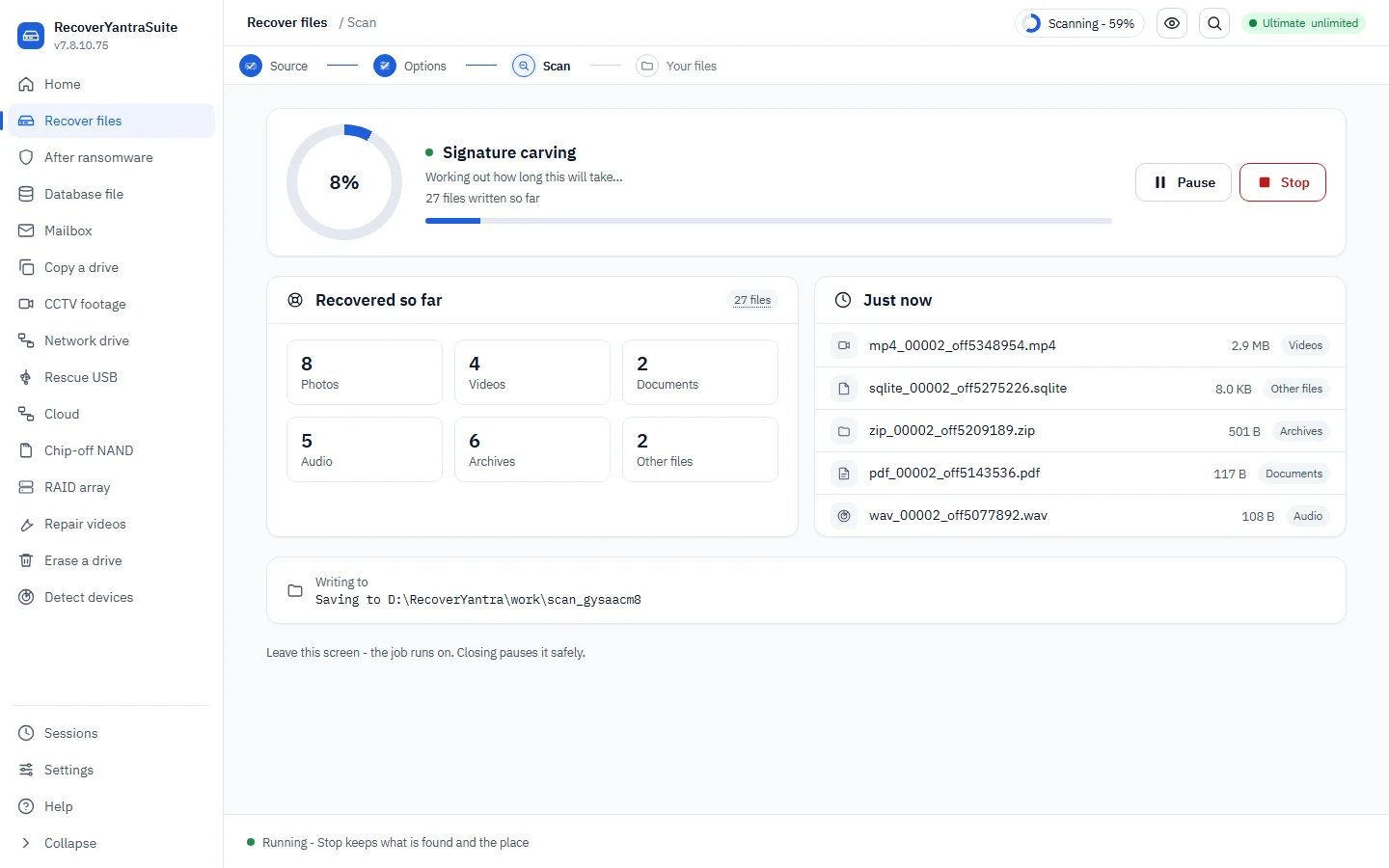
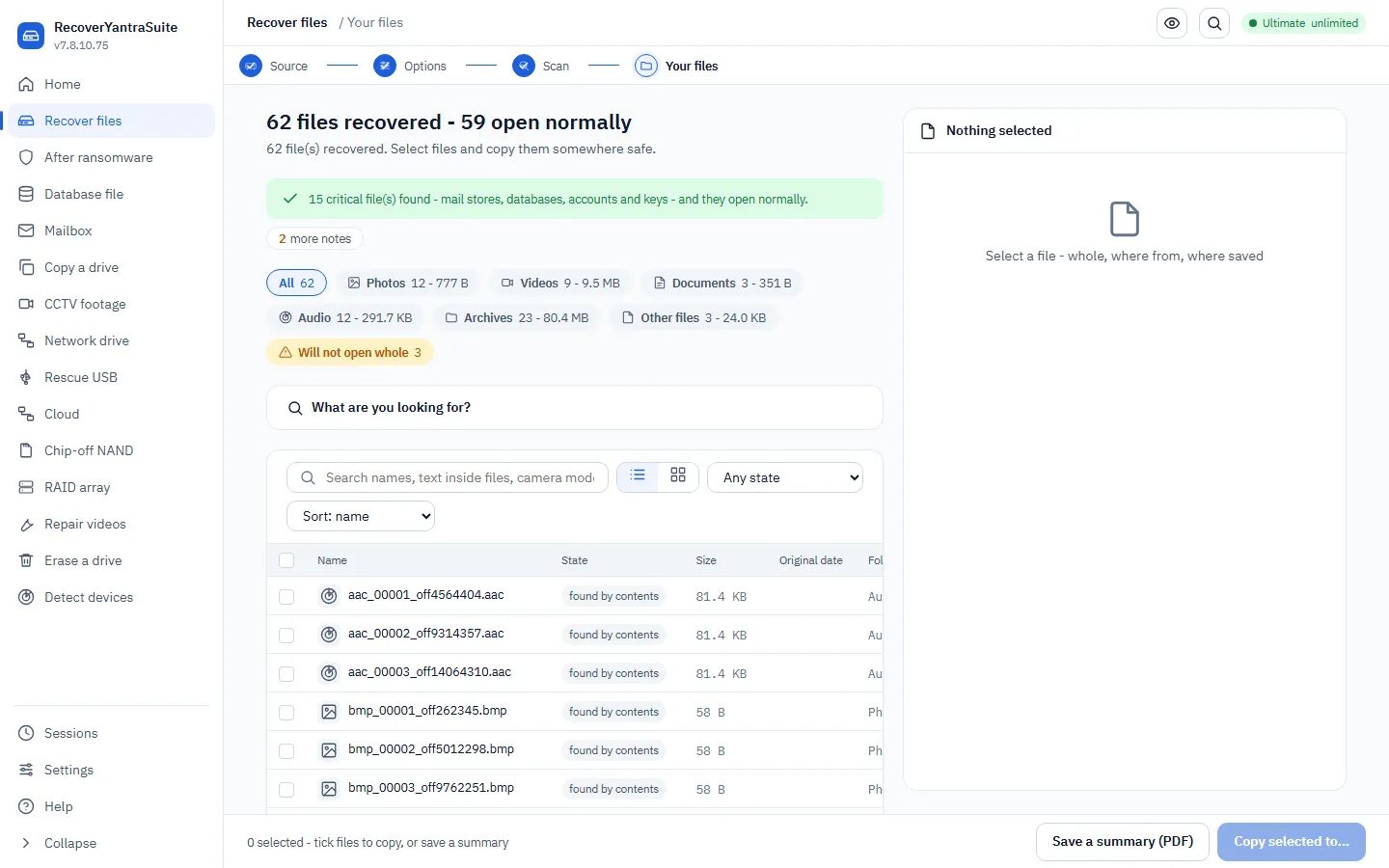
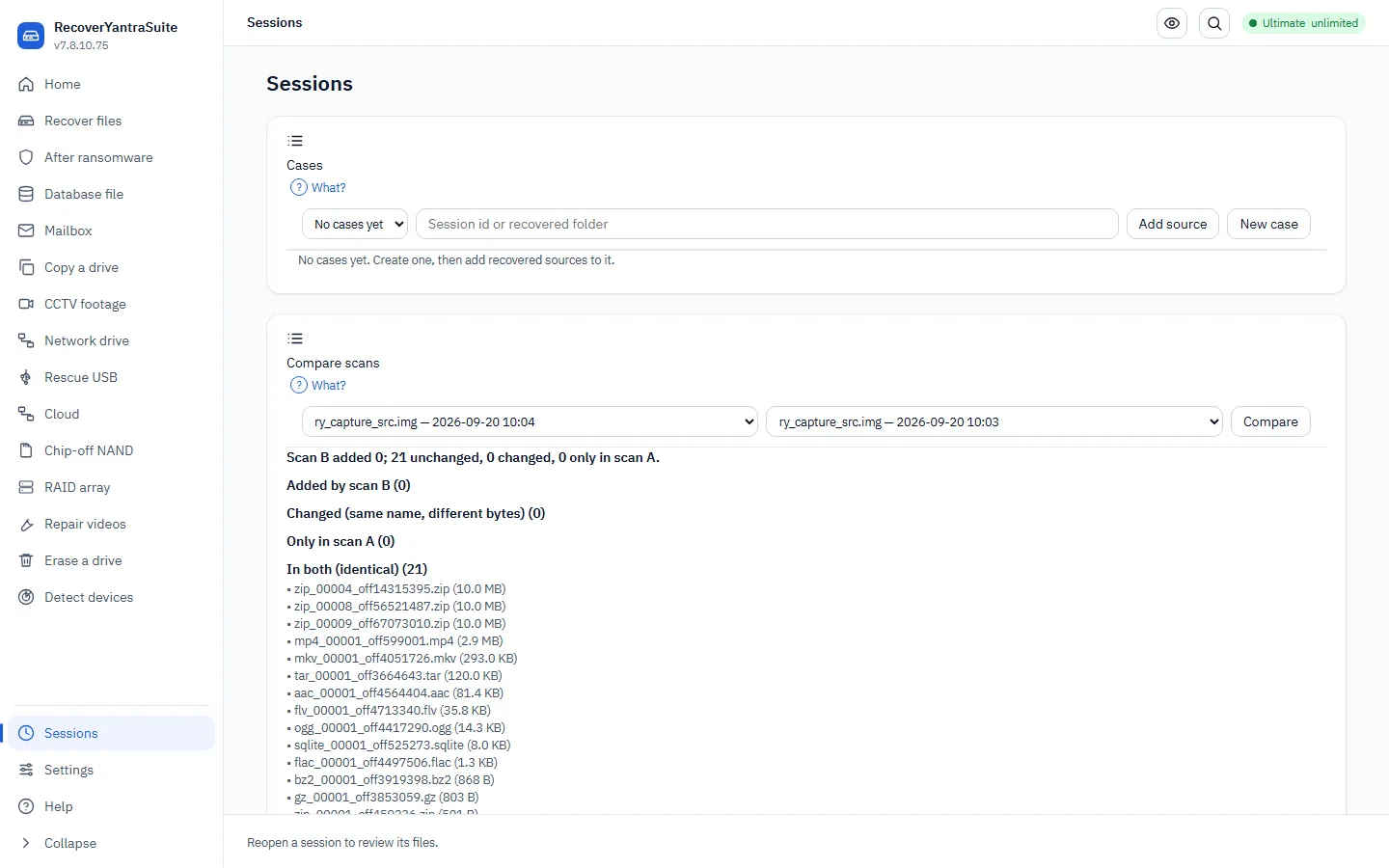
Recover lost or deleted files
We'll ask a few simple questions, then find your files. Your original drive is only ever read, never written to.
- Stop using the drivesafety - cannot skip
Before anything else: unplug it, or stop saving to it. Every file written to a drive can land on top of the one you are trying to get back, and once that happens no tool can undo it. If the drive is the machine's own system disk, shut the machine down and read the drive from another computer.
Universal first instruction in data recovery. R-Studio, UFS Explorer, Klennet and DMDE all lead with it.
- Is the drive healthy or is it failing?
We read its SMART data and try a few sectors at both ends, because flash dies from one region outwards. This is the question that decides everything after it: a failing drive must be copied before it is scanned, because every extra hour of scanning is an hour it might not survive. For the full measured answer - the recoverable-or-not verdict, with the unreadable fraction as a range and a PDF report - run the quick check on the source step ('Can it be recovered?'), or `check` on the command line.
Assess before you act. The step every professional recovery workflow puts first and the one this product previously asked the user to guess at.
- What are you recovering from?
Pick the kind of storage. This helps us read it the right way.
- Make a copy first, or recover directly?
If the health check found ANY unreadable sectors, copy first - we then work on the copy and the drive is read once instead of repeatedly. Recover directly only when the drive read cleanly and you are in a hurry.
Image first, work from the image. ACPO principle 1 in forensics; standard practice in recovery.
- Where should the recovered files be saved?safety - cannot skip
Choose a folder on a DIFFERENT drive. We never save onto the drive you're recovering - that could overwrite the very files we're trying to get back.
- What happened / what do you want back?
This focuses the VIEW, not the scan - we always recover everything, so you can widen it afterwards without scanning again.
- Which device is it?
Pick the exact drive from the list. Removable drives are shown; the drive this program runs from is disabled so you can't scan it by mistake.
- Ready to start?safety - cannot skip
We'll show you the drive we'll read, the folder we'll write to, and the free space - then begin. Nothing is written to the source.
- Look at the files before you keep them
Open a few before exporting. A file can come back with the right name and the right size and the wrong contents, if the space it used was reused after deletion - previewing is how you find that out while it still costs nothing.
Preview before recovery. Offered by every major recovery tool and the step this wizard omitted.
- Check what came back
We confirm each exported file matches what we recovered, and tell you plainly about any we could not read whole. Files we know are wrong are marked, never quietly handed over.
Verify the output. In forensic mode this is a SHA-256 manifest; in recovery mode it is a readability and completeness check.
Find the one file you actually wanted
You already have your files back. This narrows the results down to the one you actually came for, using the three things you can usually answer even when you cannot remember the filename: roughly when, roughly what kind, and roughly what it was called.
- Roughly when did you last see it?
A date range is enough - a month, or just a year. We match it against whichever date survived on each file (created, modified or last accessed); a file that kept none of its dates cannot be matched this way and is left for the other two questions to find.
- Roughly what kind of file was it?
Photo, video, audio, document or archive - the same groups the results screen already sorts everything into, so narrowing here never excludes a format quietly.
- Roughly what was it called?
A part of the filename is enough - "tax", "IMG_2021", "invoice". This matches the name only, not what is inside the file.
- See the matches
Every match is shown with the trust grade already worked out for it - a file whose contents do not match its name, or that came back empty, is marked so before you open it rather than after.
No surveyed data-recovery competitor documents this last step at all - they report a count and offer a preview.
Recover from a virtual machine / virtual disk
We read the virtual disk directly and recover the files inside it, just like a real drive. The disk file is only ever read.
- Which virtual disk format?
This is the file the VM uses as its hard disk. We read all the common ones.
- What do you need back?
Files from inside the disk, or the whole disk carved (for a deleted/corrupt VM).
- Where is the virtual disk file?
Point us at the .vmdk/.vhdx/.vdi/.qcow2 file (or a copy of it).
- Where should recovered files be saved?safety - cannot skip
A separate drive - never inside the virtual disk or its folder.
- Recover
We open the virtual disk (`recover --image <file>`), read its filesystem, and recover files - including deleted ones. A snapshot chain is followed to its current state.
We'll work out what's recoverable without ever paying - starting with the files that were never really encrypted.
- First, preserve the evidencesafety - cannot skip
Do NOT delete the encrypted files or the ransom note, and don't wipe the machine. Keep the note, a sample of the malware, and - if the machine is still on - a memory image. We'll explain each.
- Point us at the affected files
Choose the folder (or a copy of the drive) that was hit. We only read it.
- Where should recovered data be saved?safety - cannot skip
A clean, SEPARATE drive - never the infected one. Keep the encrypted originals too; a decryptor may appear later.
- Find the free wins
We check every file: some were only renamed or fake-encrypted and come back with no key at all.
- Your recovery plan
We identify the family, look for surviving originals and any known weakness, and give you an honest plan - including when the files themselves can't be decrypted.
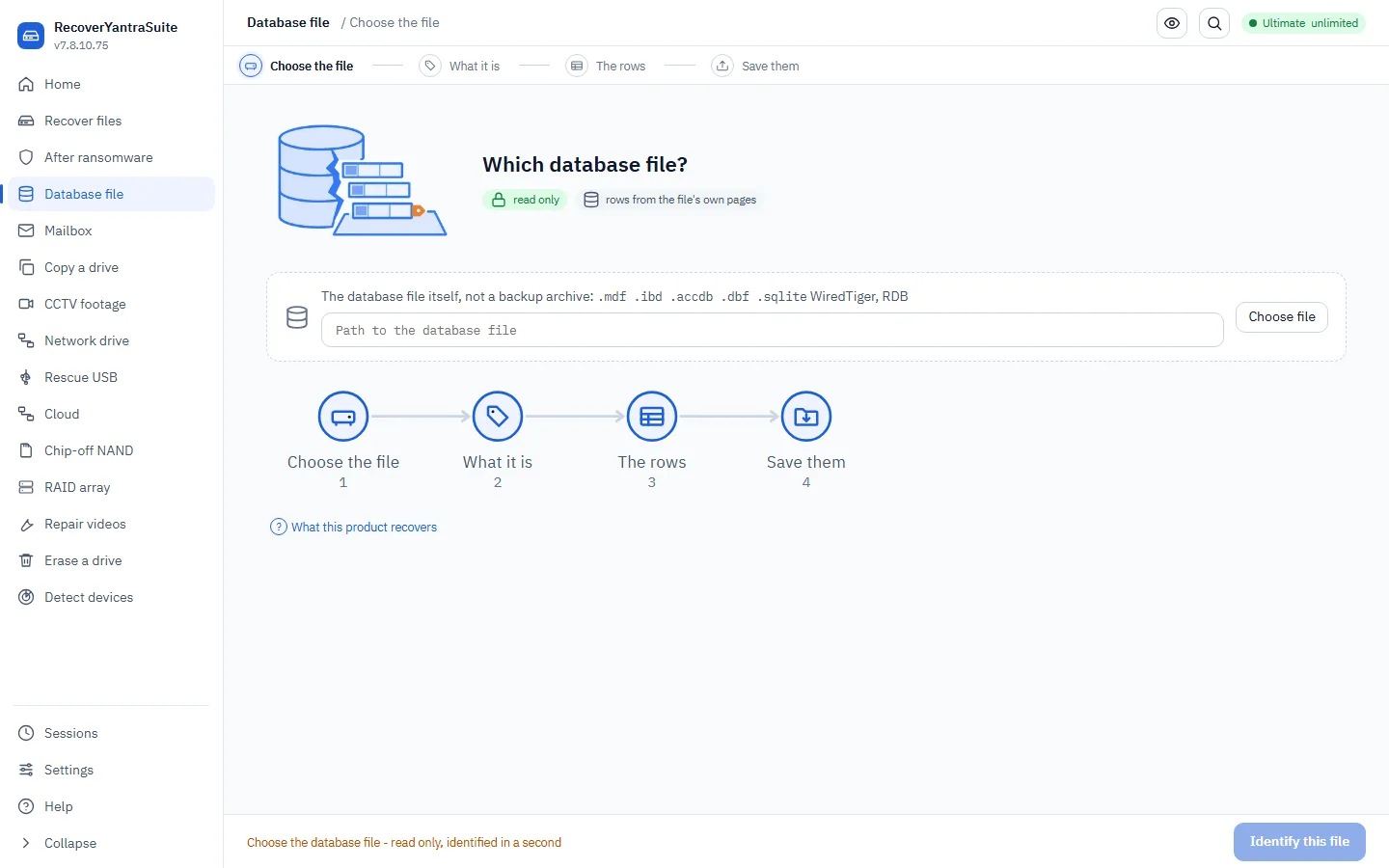
Databases need care: a running server must not be read raw. We'll find out the situation first.
- Is the database server running or stopped?safety - cannot skip
If it's running, we must NOT read the live file - it would be inconsistent. We'll guide you to stop it or take a snapshot.
- Which database is it?
We can also detect this from the file. It sets how we read the pages.
- What happened?
This chooses the technique.
- Do backups exist?
Always check first - restoring a good backup beats forensic extraction.
- Where should recovered data be saved?safety - cannot skip
A separate drive. We save extracted rows to a NEW database or CSV and keep the damaged original.
- Recover
We extract what's readable and tell you honestly what is validated versus lost - never a best-guess row.
Mailbox recovery (Outlook PST/OST, mbox, Maildir)
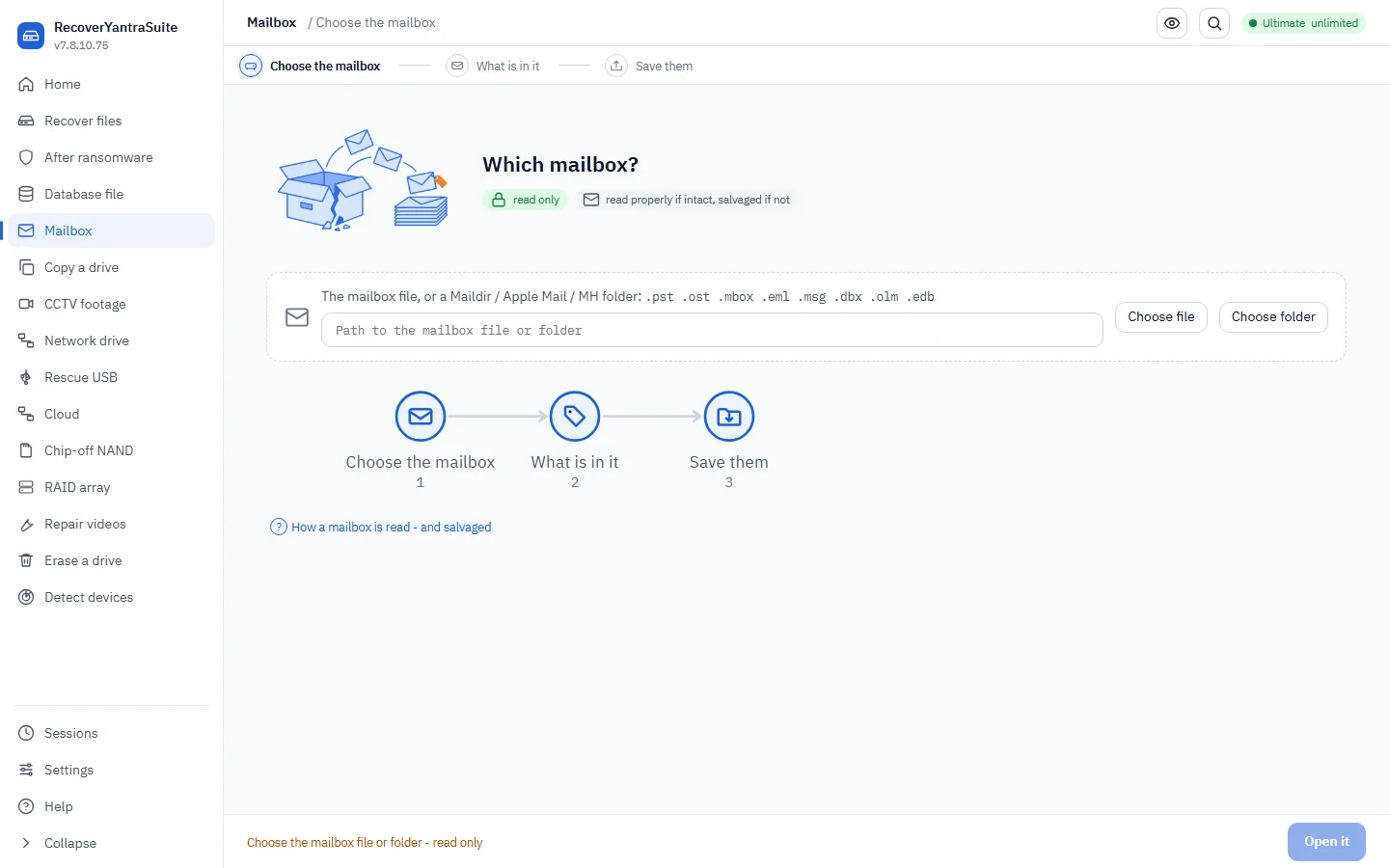
A mail store that Outlook will not open is the case people actually turn up with. We read the healthy structures first and, when those are gone, sweep the file for the messages themselves.
- Which mail store?
A .pst or .ost, an mbox, a Maildir folder, loose .eml files, or an Exchange .edb. If it came off a drive you are recovering, point us at the recovered copy, not the drive.
- What is in it, and is it healthy?
We report how many folders and messages we can see. A store Outlook calls damaged has lost the structures a normal reader depends on, so we sweep for the messages directly - anything found that way is marked salvaged everywhere it travels, because a salvage and a clean read differ in what they can give you.
- Where should the messages be saved?safety - cannot skip
A folder on a different drive. Messages are written as .eml with an index.csv, because two thousand loose files is not a mailbox anybody can use.
- Save them
Exported as .eml so they open in Outlook, Thunderbird and any review platform.
Image a failing drive
In RecoverYantraSuite, SakshyaYantra Forensic Suite, RecoverYantra Imager
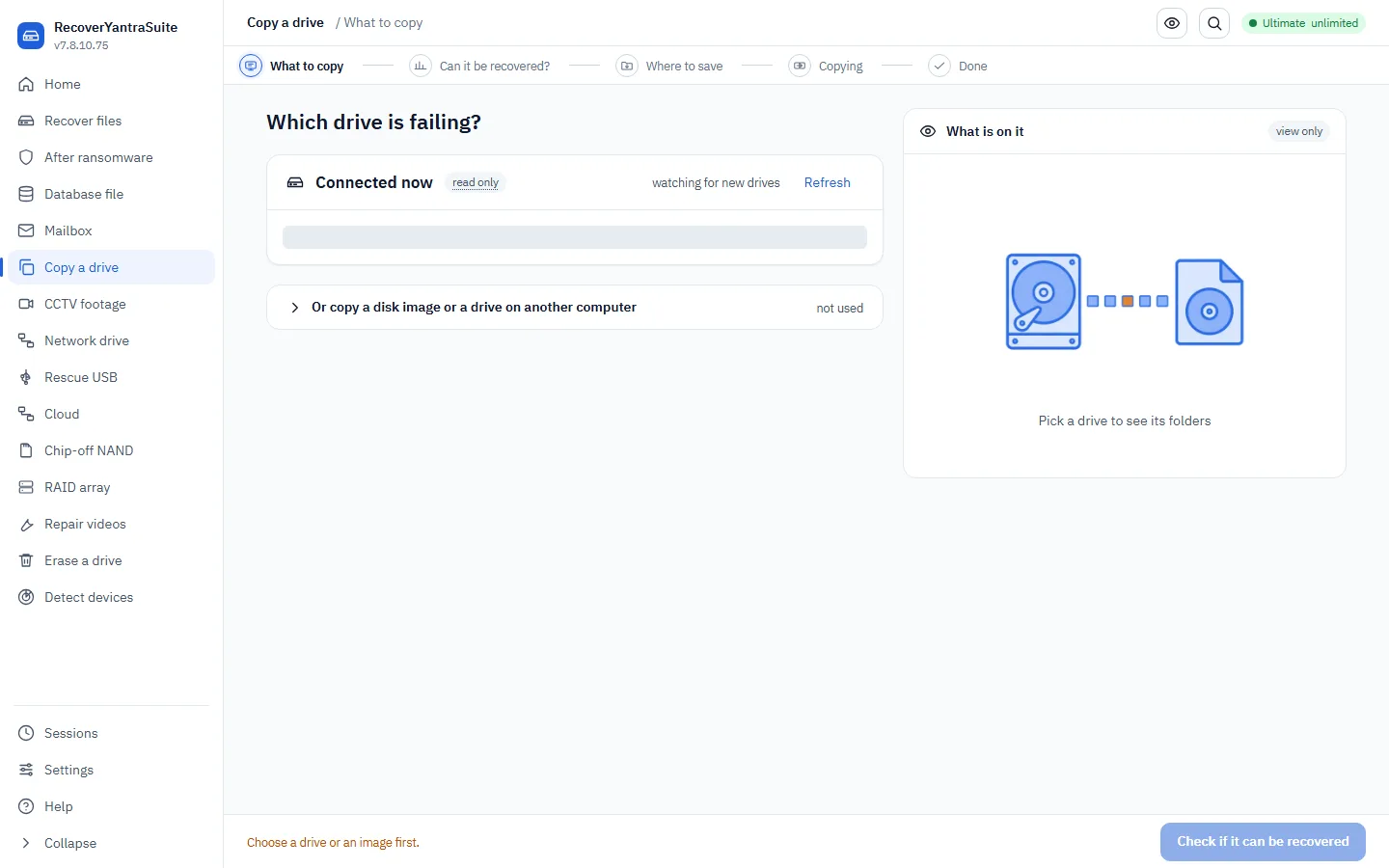
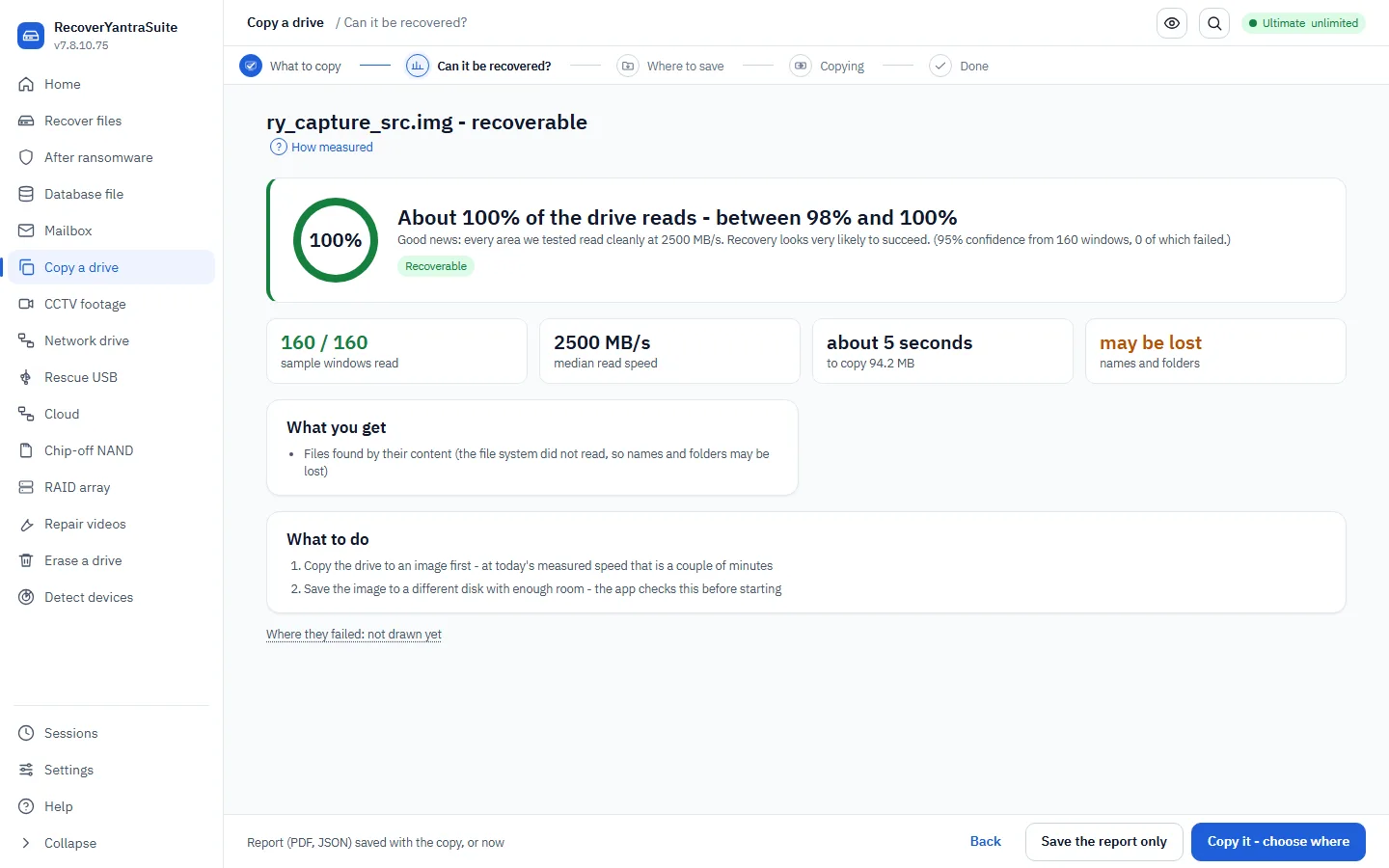
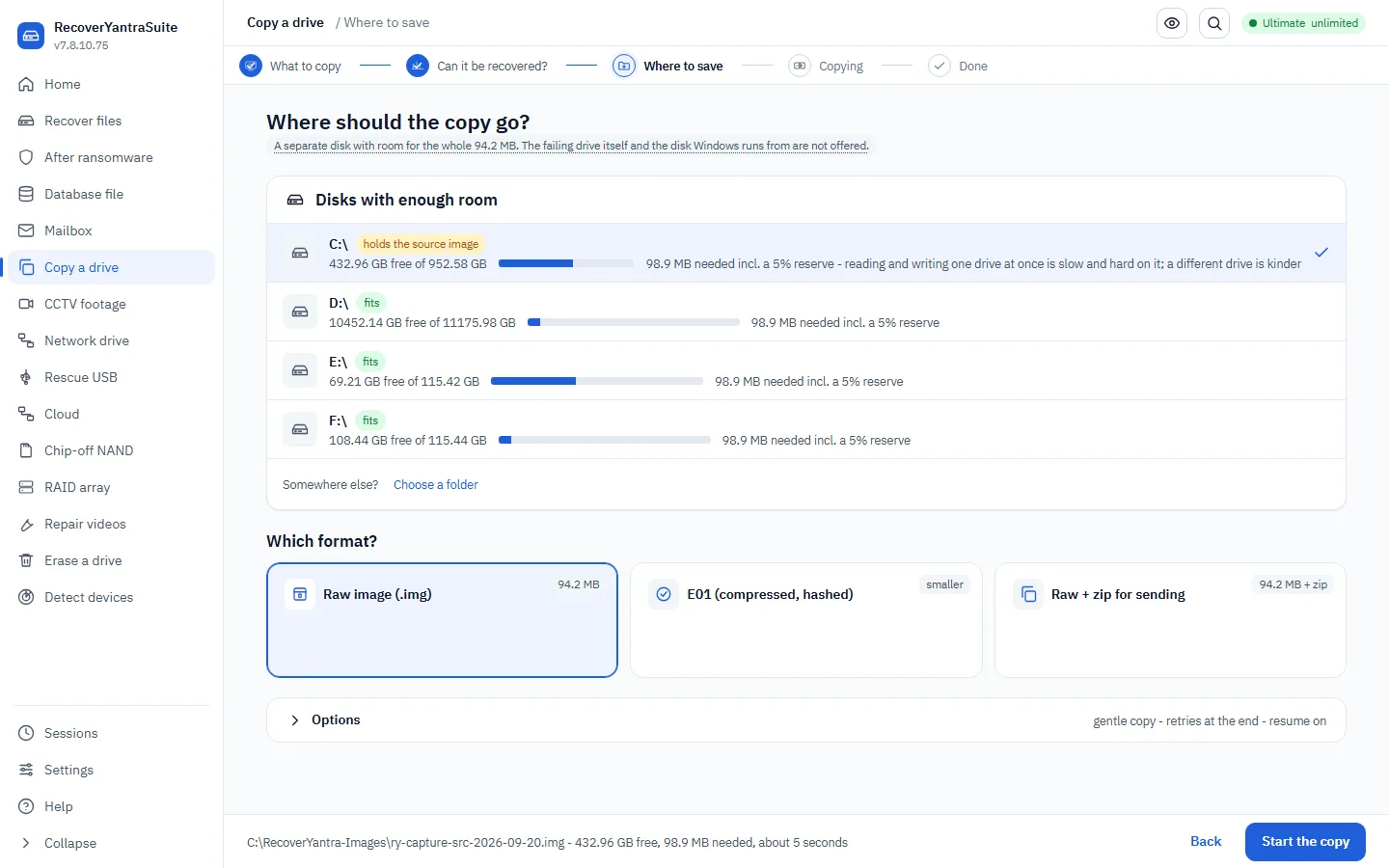
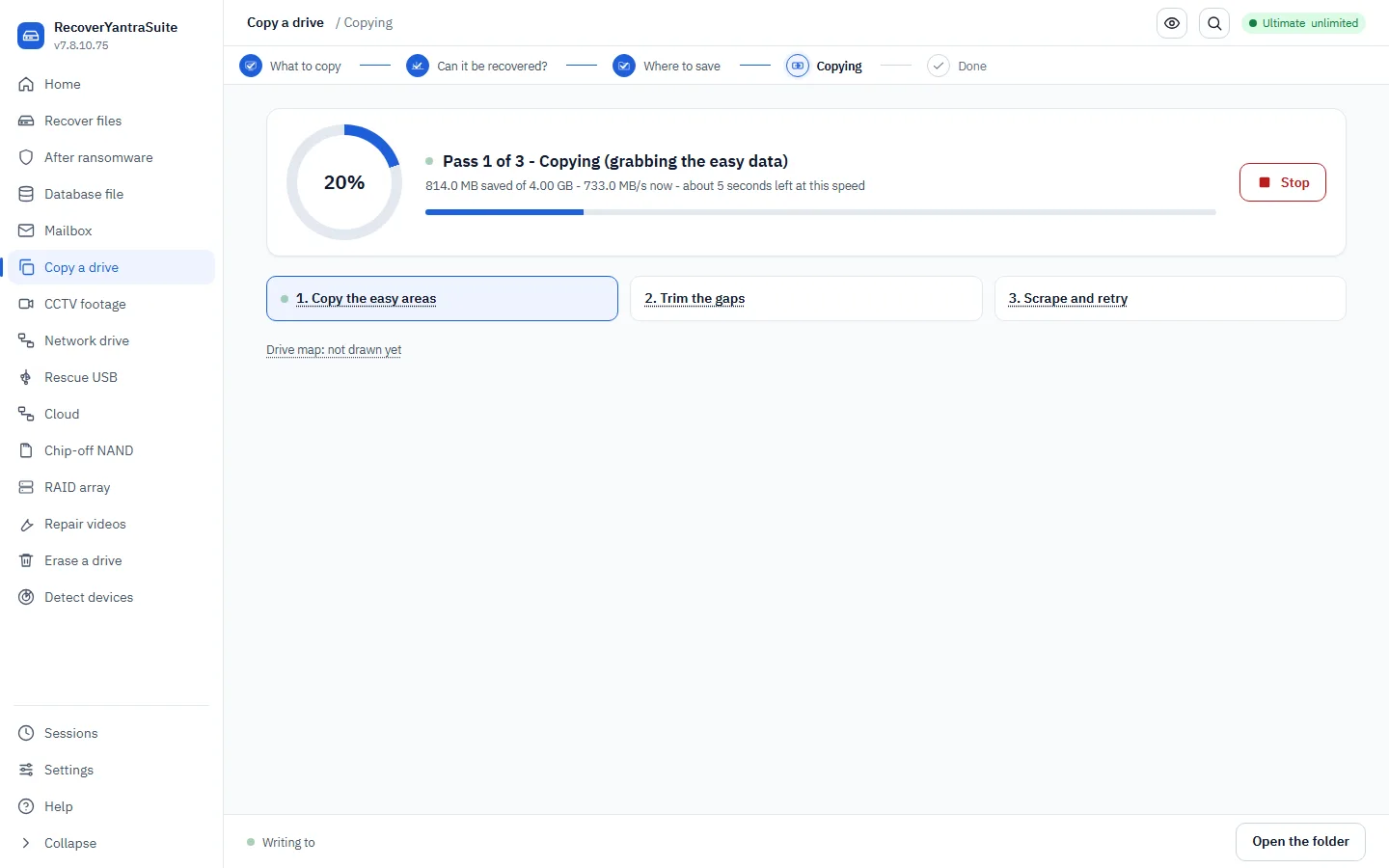
First we CHECK the drive and tell you plainly whether recovery is realistic. Then we make a faithful copy - gently, so a failing drive isn't stressed - and you recover from the copy.
- What do you want to copy?
A drive, a phone, or an existing image file. Phones have their own guided steps.
- Can it be recovered?
Before any copying, we test areas right across the drive and tell you the chances: how much is unreadable, what you can expect back, and what cannot come back. You get the answer as a PDF report you can keep or send to us.
Assess before you act - the step every professional recovery workflow puts first.
- Where to save the image?safety - cannot skip
A separate drive with room for the whole source - the app lists your drives with their free space and refuses the drive being copied. Choose raw (.img) or E01, the compressed format recovery labs open directly.
- Start the copy?safety - cannot skip
We copy in passes, skipping bad areas first and retrying them gently, and keep a map of what couldn't be read. You can stop at any time and continue later.
- Sending it to a lab?
An E01 is already compressed - hand it over as it is. A raw image can be zipped here; any lab can open a zip.
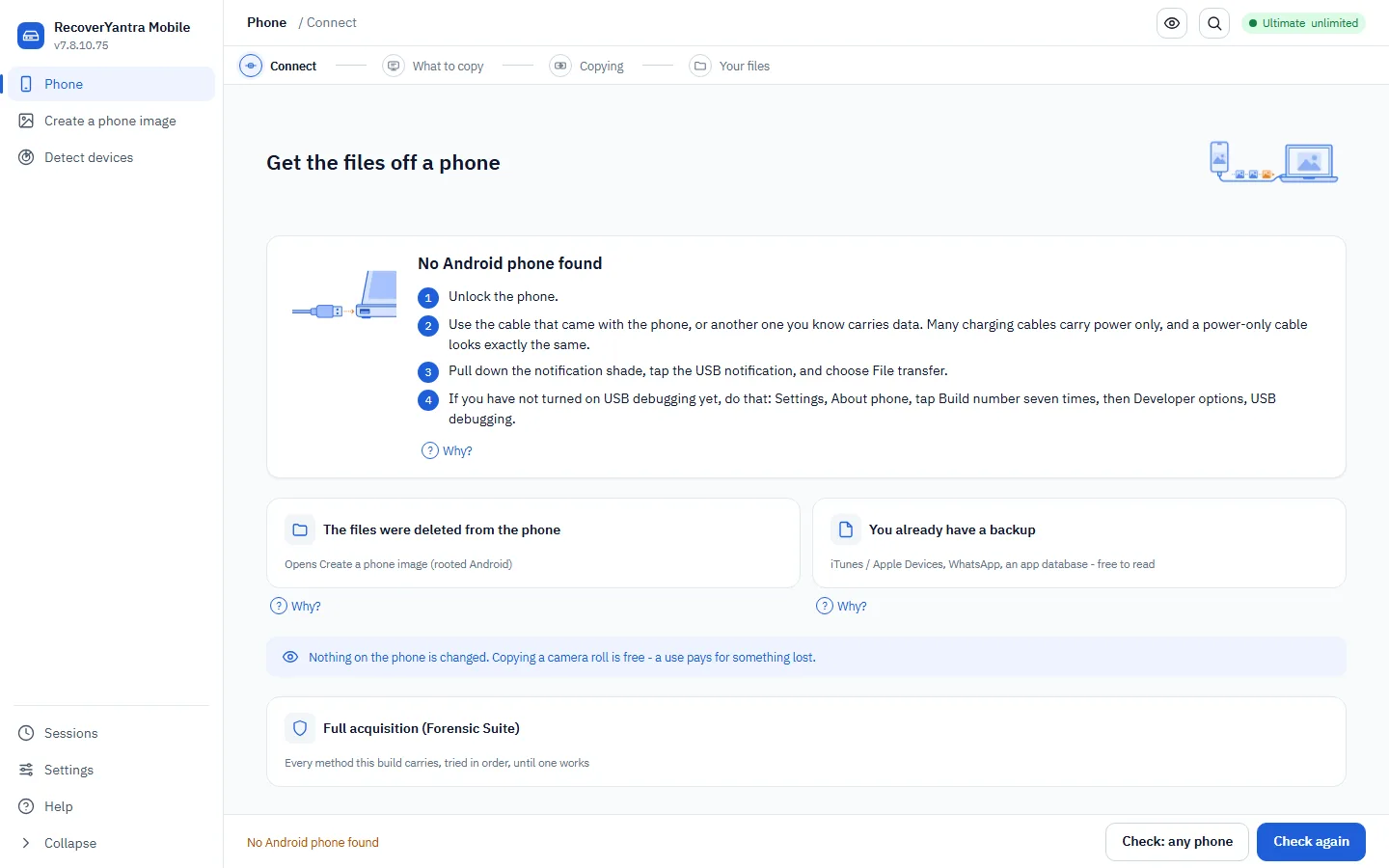
We copy what a connected phone will give us, read-only. Some steps require you to confirm you're authorised.
- Android or iPhone?
This decides how we connect.
- Confirm lawful, authorised usesafety - cannot skip
Phone acquisition is only lawful with the owner's consent or proper authority. This acknowledgement is recorded and cannot be skipped.
- Connect and unlock the phone
Plug in the phone, unlock it, and approve the trust/USB-debugging prompt on its screen. We check we can actually read it.
- Which methods may we use?
Read-only copy is always available. Advanced methods (backups, supported BootROM/EDL paths) are opt-in per case.
- Where should the data be saved?safety - cannot skip
A separate drive with enough space. We check first.
- Copy the data
We copy what's exposed, verify each file's size, and report honestly what could and couldn't be read.
Create a phone image
In RecoverYantra Imager, SakshyaYantra Mobile Workbench, RecoverYantra Mobile
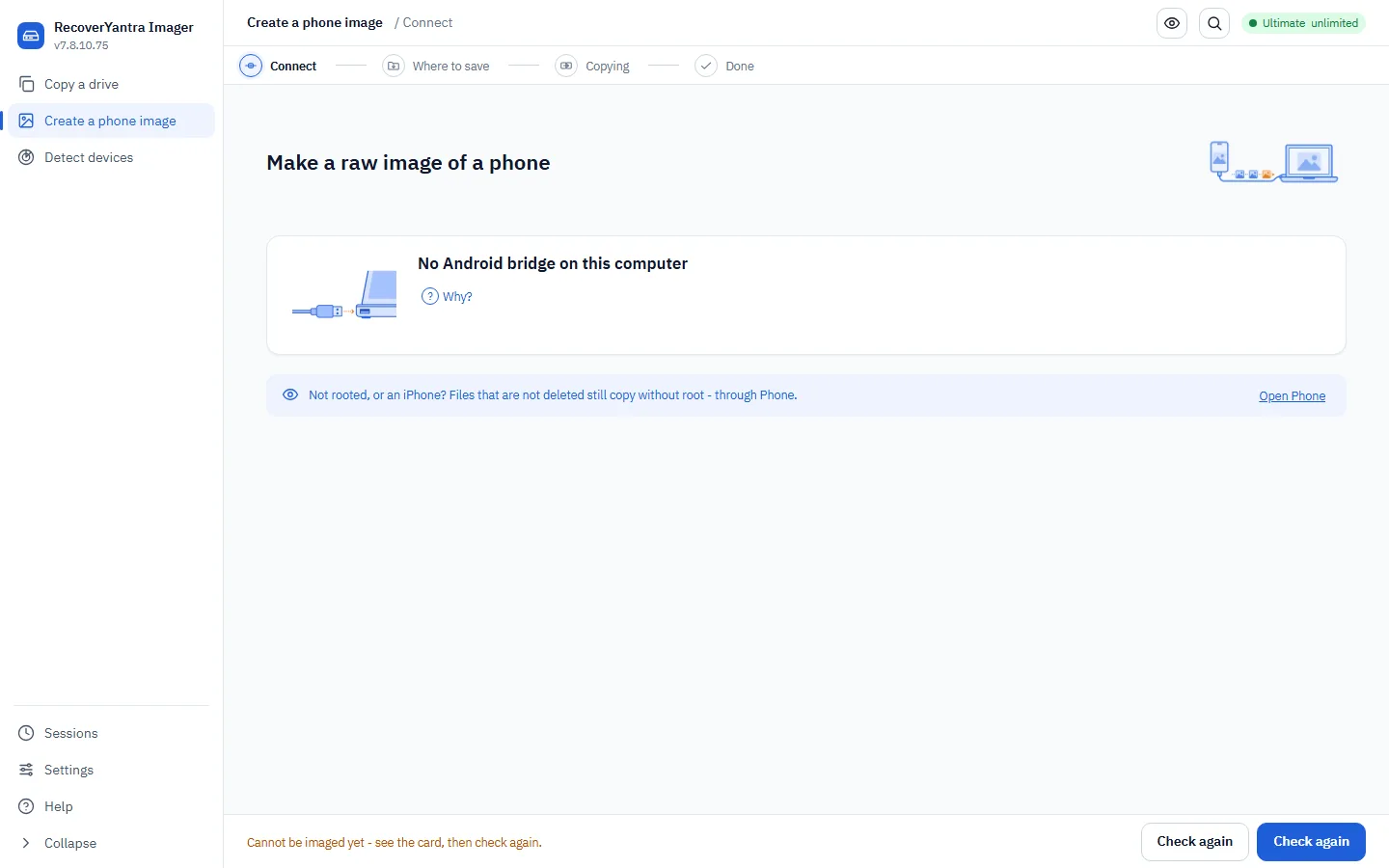
Copies a rooted Android's storage to an image file you can then work on, so the phone is read once instead of repeatedly.
- Connect the phone
USB debugging on, and the phone unlocked at least once since it was restarted - files stay encrypted until then, so a locked phone lists fine and reads nothing.
- Where should the image be saved?safety - cannot skip
A drive with room for the whole partition.
- Copying
Streamed in blocks with a live figure and a stop that stops. We compare the length against what the phone reported: a short image is reported failed, never handed over as whole.
- Done
The image goes into the ordinary recovery flow from here.
We recover clips from an NVR/DVR disk or image, then give you the same player, download, cutting and enhancement tools a forensic examiner has.
- Point us at the recorder disk or image
Choose the NVR/DVR disk or a copy of it.
- Read the disk's index first
Cameras against time, read from the recorder's own table in seconds - nothing is written. A disk with no table shows cameras inferred from the video itself (labelled A/B/C, never an invented channel number) and says the times are unknown rather than guessing them.
- Where should the clips be saved?safety - cannot skip
A separate drive.
- Recover the clips
We carve the video and mark any clip that may not play, so you aren't misled.
- Check a clip before deciding what to do with it
Frame count, keyframes, picture size and time base - the same player a forensic examination uses.
- Copy one clip out, byte-exact
The clip is copied as carved and verified against its own SHA-256 before you're told it's done.
- Cut just the range you need
Remuxed losslessly by default - the recorder's own compressed pictures, not re-encoded - unless you ask for the exact frame range and accept that every pixel becomes new.
- Pull out several clips at once
Every clip, one channel, or the ones you pick - copied byte-exact with a manifest of every hash.
- Cut straight off one camera, without recovering first
Point at the camera and the time you need and it comes straight off the disk - remuxed losslessly by default, using the same index you already read.
- Sharpen a frame or a range for the report
The enhanced picture is shown beside the ORIGINAL, never instead of it - the filter chain used is printed and both pictures are exported, so nobody has to take the enhancement on trust.
SWGDE Best Practices for Image Analysis and Forensic Video Enhancement
- Capture stills for the report
A small pack of frames - no case is needed for this one, it's a plain still, not an evidence pack.
- Produce the media report
Clips, channels, times, codecs and hashes, in the same report format a recovery job uses.
Runs a read-only agent on the far machine and copies a disk across the local network.
- Pair with the other machinesafety - cannot skip
Install and start the agent there; it offers its disks read-only. Both machines show the same pairing code.
- Which drive should be copied?
The agent lists what it can offer, with size and health.
- Where should it be saved?safety - cannot skip
A local folder with room for the whole drive.
- Copying
Live throughput and an estimate. The copy is verified by hash - a transfer that looks finished and is short is the failure this must never hide.
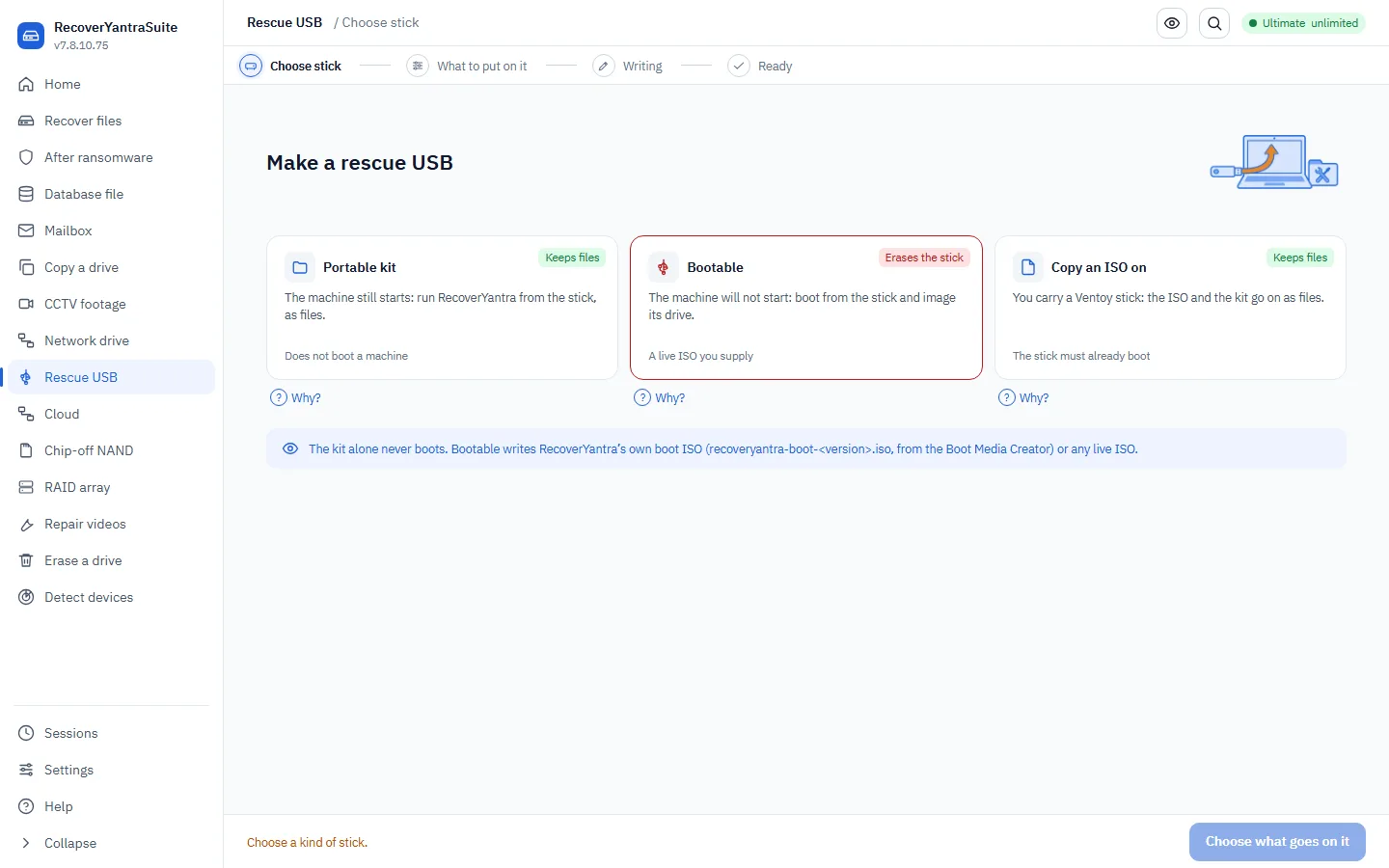
Prepares a USB stick for recovering a machine that will not start.
- Which USB stick?safety - cannot skip
Only drives whose HARDWARE reports itself removable are offered, and the system disk can never be chosen. A drive that will not identify itself is refused rather than guessed at.
- What should go on it?safety - cannot skip
The portable kit (files only, nothing erased), a bootable stick made from a live ISO you supply (this ERASES the stick), or an ISO copied on for Ventoy.
- Confirmsafety - cannot skip
We name the stick, its size and what will happen to it. Erasing needs an explicit yes and the server refuses without one, so the interface is never the only guard.
- Writing
Written, then READ BACK and compared by hash - dying flash reports a happy write and stores something else, and you would find out standing at a machine that will not boot.
Cloud data is recovered two ways: the copy synced to this computer, and the provider's own version history / restore. We do both, honestly - we can't raw-read a cloud service.
- Which cloud?
This sets where the local copy lives and which restore to use.
- Is there a synced copy on this computer?
If the account was synced here, the files (or online-only stubs) are on the local disk and we recover them directly.
- Where should recovered files be saved?safety - cannot skip
A separate drive from the sync folder.
- Use the provider's restore for the rest
For anything not cached locally, use the provider's version history, point-in-time restore, or trash window (OneDrive Files Restore 30 days, Google/Dropbox version history, S3 versioning). We tell you exactly which and how long the window is.
- Recover
We recover the local sync cache and report the provider-side restore avenue for each file that lives only in the cloud.
A recovered video whose index is damaged plays sound with no picture, or will not open at all. Where the bytes are there, this rebuilds what points at them.
- Which videos?safety - cannot skip
The recovered files that will not play. Originals are never modified - we always work on a copy.
- A working video from the same camera
Optional but it is what makes the difficult cases work: a healthy file from the same device supplies the structure the damaged one has lost.
- Repairing
We rebuild the index and correct the container header. What we CANNOT do is invent picture data that was overwritten - where frames are genuinely gone, the result says so rather than reporting a repair that changed nothing.
- Does it play?
Each repaired file is checked for a real video track and an index that points inside the file, before it is called repaired.
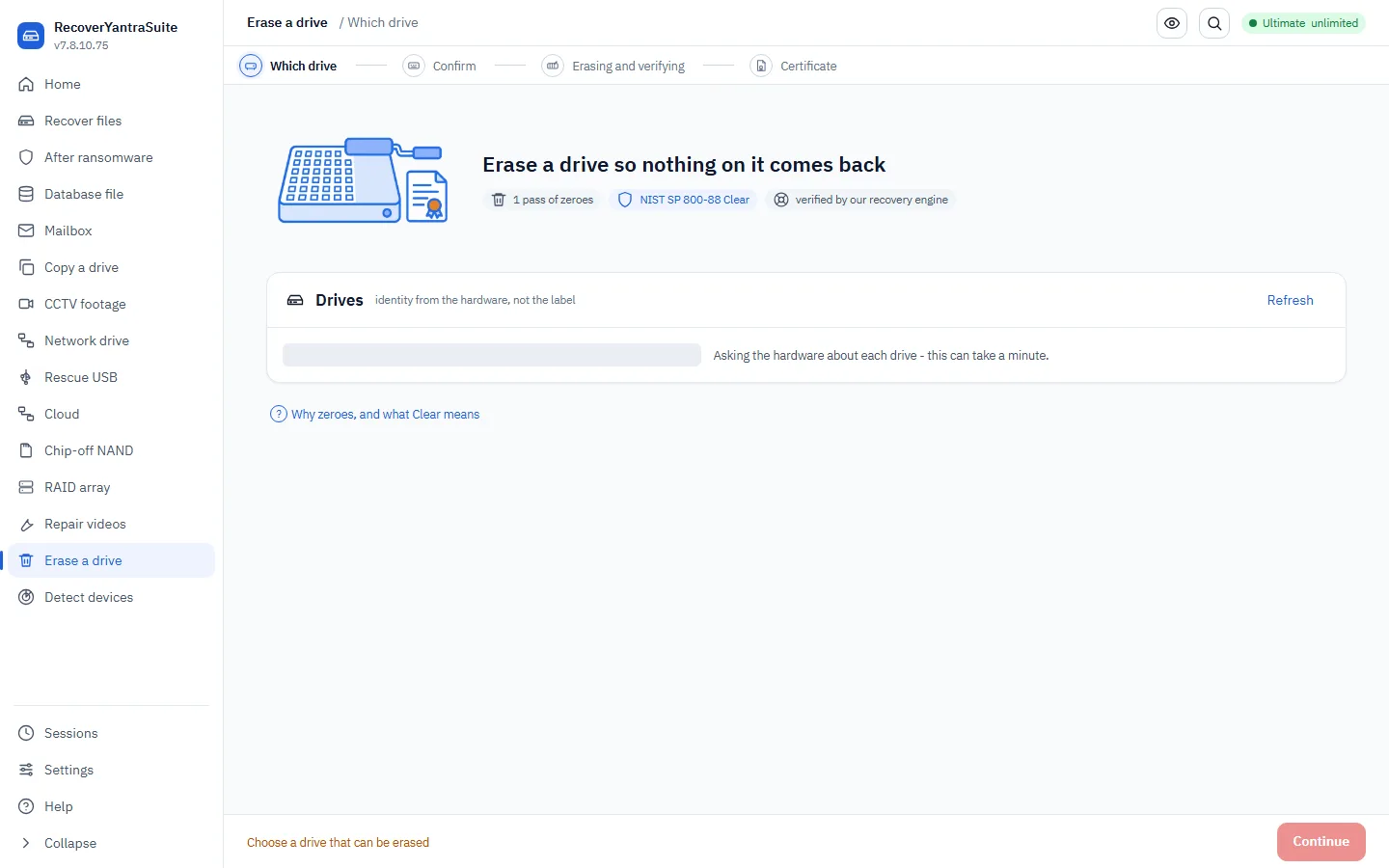
This permanently erases a drive. Here the destination IS the target - the opposite of recovery - so we confirm very carefully.
- Which drive should be erased?safety - cannot skip
Pick carefully. The system disk, the drive this program runs from, and the report drive can never be erased.
- Type the drive's serial number to confirmsafety - cannot skip
Typing the serial back proves you picked the right drive. A simple 'yes' is too easy to click through.
- How thorough?
One zero-writing pass meets the NIST 'Clear' standard and is provable (we read it back). We don't claim more than we can prove.
- Verify and issue a certificatesafety - cannot skip
We read the drive back with our own recovery engine to confirm nothing is left, and produce a certificate stating what was achieved and its limits.
Forensic examination and reporting
In SakshyaYantra Forensic Suite, SakshyaYantra Mobile Workbench
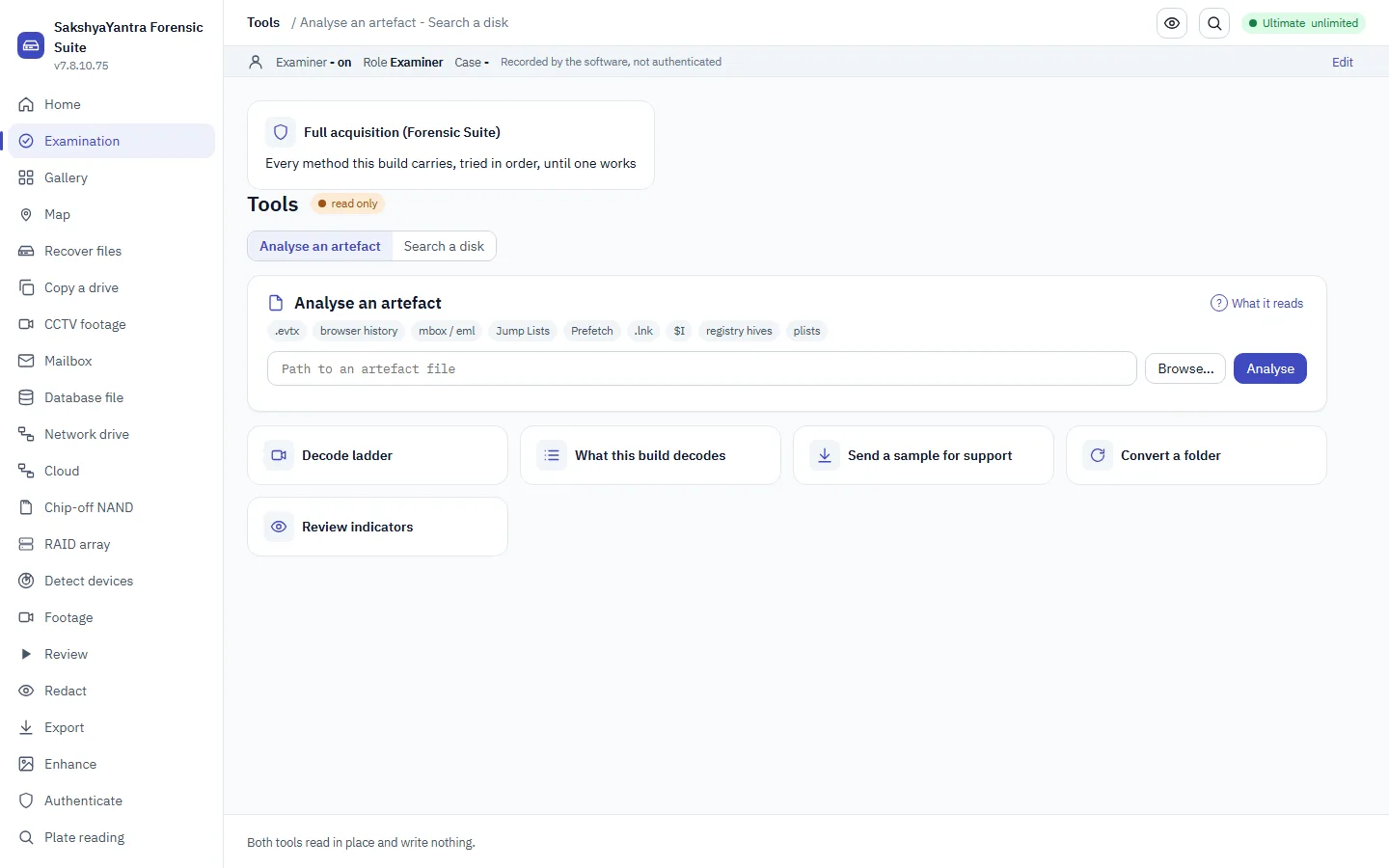
A forensic examination is judged on whether you can show what you did, not only on what you found. These steps are the published order - ISO/IEC 27037, NIST SP 800-86 and the ACPO principles - and the audit trail is written as you go.
- Record the authority and the scopesafety - cannot skip
Who authorised this examination, over what, and on what basis - the owner's instruction, a warrant, or a statutory power. Recorded now, before anything is opened, because an authority written afterwards is not an audit trail.
ISO/IEC 27037 s5.3; ACPO principle 3 (a record of all processes applied).
- Prepare, and make the source read-onlysafety - cannot skip
Attach the exhibit through a write blocker where you have one. This engine has no write path to a source at all, and we MEASURE that rather than assert it: the source is fingerprinted before and after the job and the report states which regions were checked.
ACPO principle 1 - no action should change data held on an exhibit.
- Document the exhibitsafety - cannot skip
Case reference, exhibit number, make, model, serial, capacity, and who is handling it. This starts the chain of custody, and everything acquired afterwards is filed against it.
ISO/IEC 27037 s6.7 chain of custody; NIST SP 800-86 s3.1.2.
- If the machine is running, take the volatile data first
Memory and running state are gone the moment it is powered down, so they are collected before the disk. If the machine is already off, leave it off - do not power it up to look.
Order of volatility - NIST SP 800-86 s3.1.1, RFC 3227.
- Acquire an image, hashing as you go
The image is hashed WHILE it is written, not afterwards, so the hash covers what was read from the exhibit rather than what happened to land on disk. E01 or raw; both carry the same manifest.
ISO/IEC 27037 s7.1.3; NIST SP 800-86 s3.1.2.
- Verify the image against the exhibitsafety - cannot skip
Compare the acquisition hash with the source. This is the step that makes everything after it defensible, and it is why it sits HERE and not at the end - analysing an unverified image means every finding rests on a copy nobody checked.
ACPO principle 2; ISO/IEC 27037 s7.1.4 verification.
- Work only on the verified copysafety - cannot skip
The exhibit goes back in the bag. Every examination from here runs against the image, so the original is read once and never again.
ACPO principle 1; ISO/IEC 27037 s7.1.5.
- Examine
Recover deleted files, read the artefacts - recycle bin, USN journal, prefetch, registry, LNK, event logs, jumplists, shellbags, AmCache, browser history - build a timeline, and search. Everything you do is written to the hash-chained audit trail as you do it.
NIST SP 800-86 s3.2 examination and s3.3 analysis.
- Report
The findings, the method, the tool and its version, every hash, the source offset of each recovered file, and the limits of what the examination can support. The limits are not optional - a report that states none is claiming certainty it does not have.
NIST SP 800-86 s3.4 reporting; ISO/IEC 27037 s6.8.
- Seal the trail and return the exhibitsafety - cannot skip
The audit trail is sealed - the receipt goes into the manifest, which is what makes a later truncation detectable - and the exhibit is signed back in.
ISO/IEC 27037 s6.7 - custody is unbroken to disposal.
Detect every connected device, with a report
In RecoverYantraSuite, SakshyaYantra Forensic Suite, RecoverYantra Imager, SakshyaYantra Mobile Workbench, RecoverYantra Mobile
See everything this computer can see - drives it can use, drives it can see but not use, and why - and save it as a report.
- Connect the device
Plug it straight into the machine, not a hub; a desktop external drive also needs its mains adapter.
ISO/IEC 27037 7.4 - identification of digital devices
- Read what the computer sees
Every device is listed, usable or not. One that is connected but cannot be used says why: cannot be read, needs administrator, in use, Windows cannot start it, or a phone in MTP mode.
- Do what the row says
A card the reader cannot address needs an SDXC reader; a bridge Windows cannot start needs power, cable, a USB 2.0 port or a different enclosure; a drive that reads but is failing goes to Image, not Scan.
- Save the report
HTML, PDF and JSON, with every device, its state, the Plug-and-Play inventory and the environment. Send it with any support request about a drive that is not detected.
Is this recording what it claims to be. Every method is run and reported with what it can and cannot see; the answer is a ranked set of hypotheses with the methods for and against each, never a score alone.
- Choose the file
The recording as received, hashed first. Model packs are optional and, when used, are named in the record.
- Read the methods
Structure, codec history, double compression, frame statistics, model outputs - each with its result and its refusals. A method that cannot judge this file says so.
SWGDE Best Practices for Digital and Multimedia Evidence Authentication - method-based, documented.
- Read the ranking
Each hypothesis names the methods that support it and the ones that oppose it. The examiner writes the conclusion; the software ranks the evidence.
ISO/IEC 27042 s9 - interpretation stated with its basis.
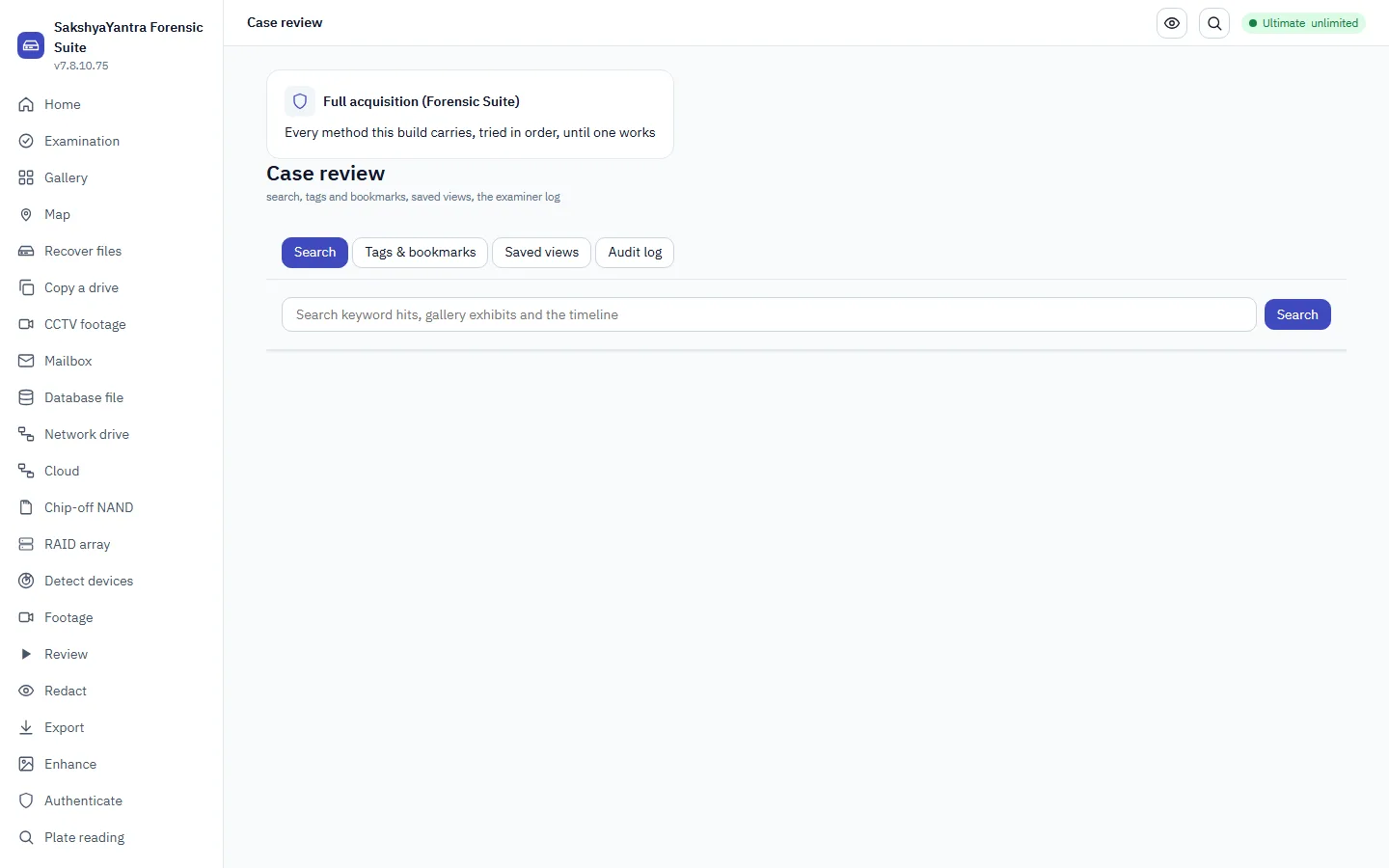
One place to search the case's keyword hits, gallery and timeline; review every tag and bookmark; save a named filter for later; and read the case's own hash-chained action log.
- Search the case
Fans out to the keyword hit search, the gallery and the timeline's own text filter - no new search engine, the same ones those workspaces use.
- Review tags and bookmarks
Every finding and bookmark recorded anywhere in the case, filterable by kind, with its review state.
- Save a filter for later
Named presets held with the case itself, so the next examiner sees them too.
- Read the examiner log
The case's hash-chained trail, verified on the same screen: an altered, inserted or reordered entry is detected, not assumed absent.
ISO/IEC 27037 7.6 - documentation
A triage question over the case's own indexed data - timeline, entities, messages, artefacts. Retrieval is the case's own data and needs no gate; a model answer is an observation, never a finding, and its words are shown only after you seal your own reading first.
- Ask a question
The case items that bear on the question come back with the verdict. A claim that cites a case item which does not exist refuses the whole answer; nothing is invented.
- Seal your own reading
Type your reading of the case, or mark it inconclusive. It is sealed into the audit trail before any model words are shown.
- Reveal the model's words
An audited event. The model's text is disclosed as an observation, labelled the model's words and never the case's.
A hash, a phone number or an email that turns up in more than one case is a lead. This keeps a lab-wide store of those values and tells you which authorised cases share them, so a connection between two cases is not left to memory.
- Look up a value
Search the lab-wide store for a hash, phone, email or account and see every authorised case that carries it.
- Add a case to the store
Adding a case is an explicit, authorised act, never automatic on save. A case stored without authority is never shown as a correlation of another.
- Correlate a case
See what the current case shares with every other authorised case - stated plainly when there is nothing, never a blank screen.
A clip cut losslessly where the container allows, its provenance record beside it, and the draft Section 63(4) certificate built from the case's own records.
- Choose the clip
Which asset and which frames. Leave the range empty for the whole asset.
- Write it with provenancesafety - cannot skip
Lossless by default; where a container cannot be cut on a frame the policy says so and the record says which. The provenance record is verified against the clip after writing.
ISO/IEC 27042 s8 - derived items hashed; SWGDE s10 - output documented.
- Draft the certificatesafety - cannot skip
The device, the person in charge of it, the expert and the place, typed; every record it rests on named by digest. A draft for a person to read, sign and file.
Bharatiya Sakshya Adhiniyam 2023 s63(4) - the certificate for electronic records.
See what is on the drive in seconds, tick the files or folders you want, and recover only those - instead of waiting for the whole drive and picking afterwards.
- See what is on the drive
We read the index - the filesystem's own record of names and folders, deleted entries marked - without touching any file's contents. Seconds, and free.
Browse before recovering. R-Studio and DMDE both read the index first and let you choose.
- Tick what you want back
A ticked folder covers everything under it. Find by name, modified date or minimum size; deleted entries carry their recovery chances so you know before you commit.
- Where should the recovered files be saved?safety - cannot skip
A folder on a different drive. Only the ticked files are read and written - the destination never holds more than that.
- Recover the selectionsafety - cannot skip
Only what is ticked is read from the source and written out, under its own folder path rather than sorted by type.
- Check what came back
The same completeness check a full recovery gets, scoped to the files you actually asked for.
A recording is not evidence until it has been read, hashed and recorded. Probe it, decode it through the ladder, and put the result in the case with the examiner named.
- Choose the recording
A recorder export, a clip from a phone or a pen drive, or the folder a recovery wrote. It is opened read-only and hashed before anything else happens.
ISO/IEC 27037 s7.1 - identification and collection of the original.
- Read what it is
Two readers on purpose - the container parser and the decoder's probe - and a disagreement is shown as one. The recorder registry says whether this make and model has been tested.
SWGDE Best Practices for Forensic Video Analysis s5 - characterise the recording before processing.
- Decode it through the laddersafety - cannot skip
Container, index, stream, then salvage: the rung that produced each frame is recorded, and a frame the index had lost is marked salvaged rather than passed off as normal. Written to a folder on another drive.
ACPO principle 1 - the original is not changed; ISO/IEC 27042 s7 - reproducible processing.
- Put it in the casesafety - cannot skip
The decode result, the source hash and the examiner's typed name become the exhibit record. This is where one USE of the licence is spent - one source, however many frames.
ISO/IEC 27037 s6.6 - chain of custody from the first record.
Windows says the disk must be formatted, or shows it as RAW. RECOVER FIRST, FORMAT SECOND - never the other way round: the files come out through the ordinary recovery, and only then is the disk given a fresh partition table and filesystem so it can be used again. Where the hardware is failing, this refuses and says so.
- Get the files out firstsafety - cannot skip
A format destroys exactly what a recovery exists to save. This door opens only after a recovery has finished, and where the scan found files that have not been exported it refuses and says how many.
Recover before you repair - the ordering diskrepair and every professional workflow put first.
- Check the drive is fit to be formatted
Read-only, about 12 seconds: whether the disk reads at all, how many read errors, and whether it stays present and steady on the bus. A disk that drops or cannot be read is refused - formatting failing hardware only wastes what is left of it.
- Choose the filesystem
exFAT for cards and sticks used across devices, NTFS for a Windows-only disk, FAT32 where an older device needs it (4 GB file limit). The choices that do not fit the disk say why.
- Type the drive's serial number to confirmsafety - cannot skip
Typing the serial back proves you picked the right drive. The system disk and the disk this program runs from can never be formatted here.
- Format and verifysafety - cannot skip
A fresh partition table and filesystem are written, the disk is read back, and the record shows each step taken and the drive letter Windows gave it.
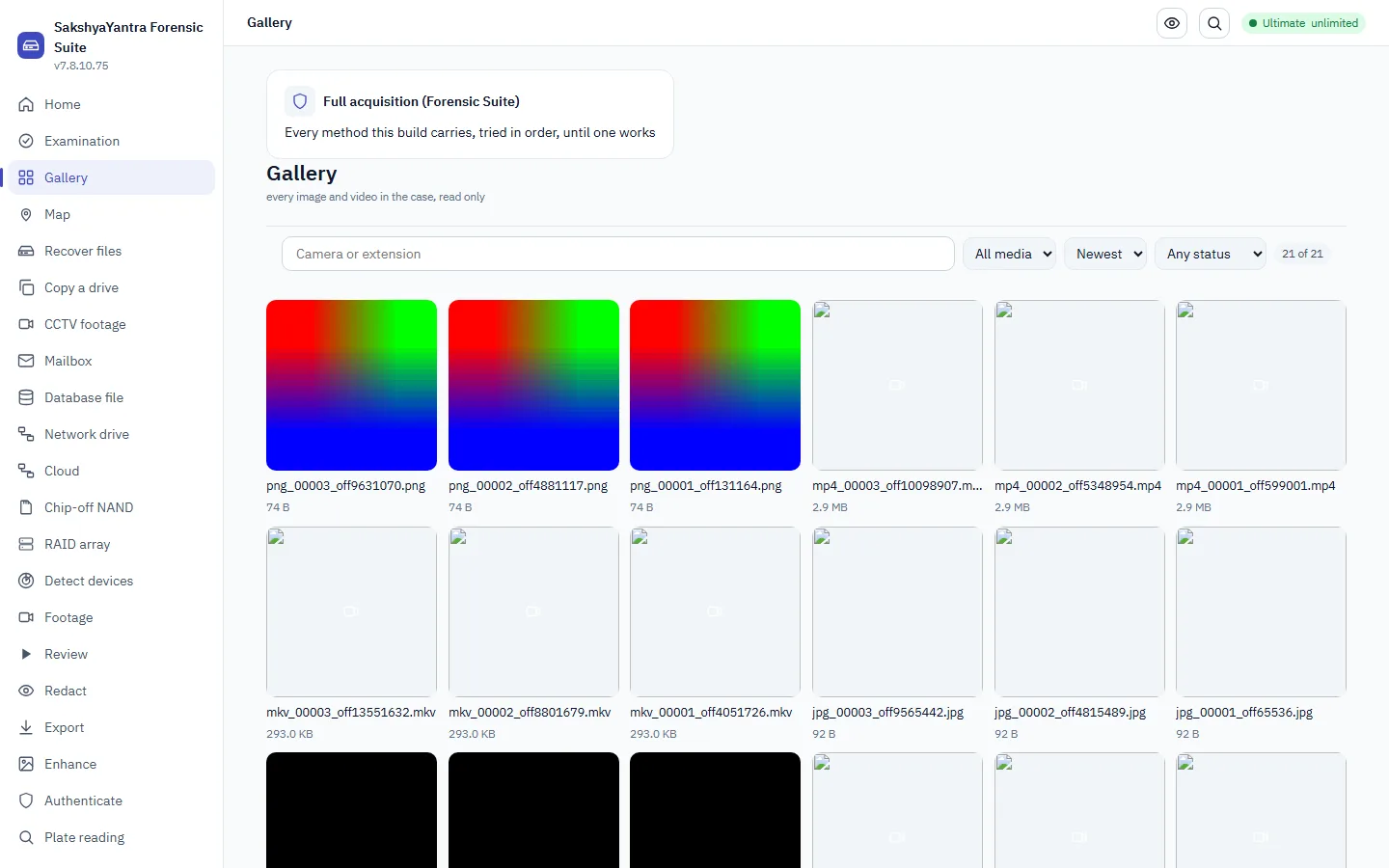
See every image and video in a case on one wall, narrow it down by type, date, camera or size, mark what matters, and open a frame full screen - the byte-exact original still leaves only through export or a frame pack.
- Open the case
The gallery reads the exhibits already in a case. Open or create the case in Examination or Footage first; the wall is then every image and video that case holds.
ISO/IEC 27037 7.5 - collection and preservation
- Look at the whole wall
Every picture and video as a tile - a video shows a poster frame. Tiles load lazily and page, so a case of tens of thousands stays responsive.
- Narrow it down
Filter by images or video, by camera make from EXIF, by extension, by date range or size, and by known-file status (unknown until a hash set is installed); sort by date, size or name.
- Mark what matters
Tag or bookmark an exhibit, or add it to a finding - each mark is written into the case through its own door and shows on the tile.
ISO/IEC 27037 7.6 - documentation
- Open a frame full screen
Open a tile to review it: a still full size, a video frame by frame through the shared frame-exact player.
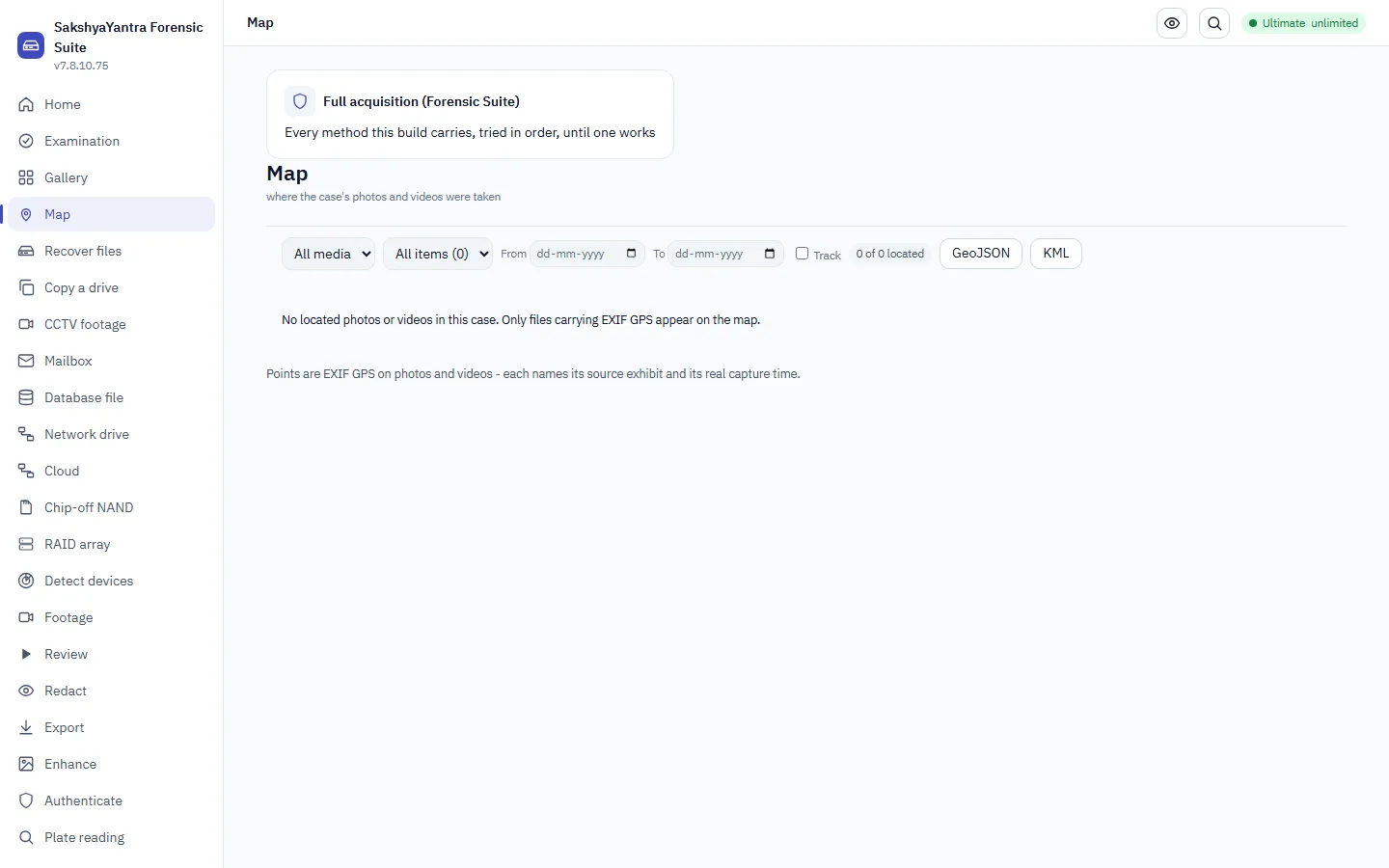
Plot every located photo and video in a case on an offline map - only files carrying real EXIF GPS appear, each on its own point with its source exhibit and its real capture time. The map works with no internet.
- Open the case
The map reads the exhibits already in a case. Open or create the case in Examination or Footage first; the map is then every located photo and video that case holds.
ISO/IEC 27037 7.5 - collection and preservation
- See the points on the map
Every photo/video that carries EXIF GPS becomes a point; nearby points cluster, and a point names its source exhibit and real timestamp. The basemap is offline.
- Narrow it down
Filter by images or video, by date range, or to a single exhibit; turn on the track to join the timed points in order.
- Open the source item
Click a point to see the exhibit it came from, and open it in the gallery for the byte-exact original.
ISO/IEC 27037 7.6 - documentation
- Export the points
Export the points to GeoJSON or KML - KML opens them, with the track and timestamps, in Google Earth, QGIS and other mapping tools.
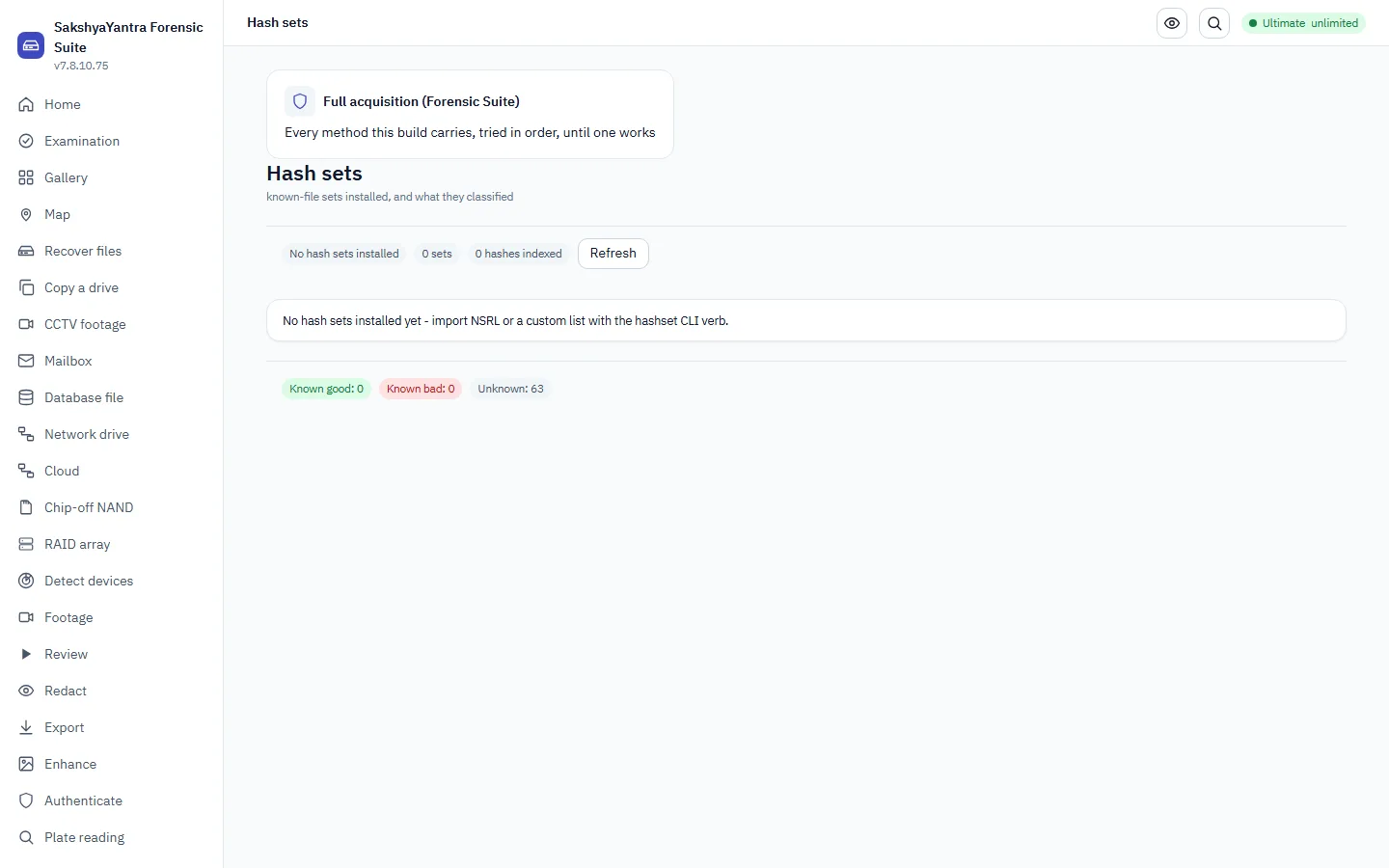
Import NSRL or a custom hash list, then see which of the case's files are known-good, known-bad, or unknown.
- Import a hash set
NSRL RDS (modern SQLite), a plain MD5/SHA-1/SHA-256 list, or a custom examiner set typed known-good or known-bad.
- Classify the case
Every exhibit's digest is looked up against every installed set; the gallery's known column and filter read the same result.
- Review the tally
Known-good, known-bad and unknown counts, and which set a known-bad match came from.
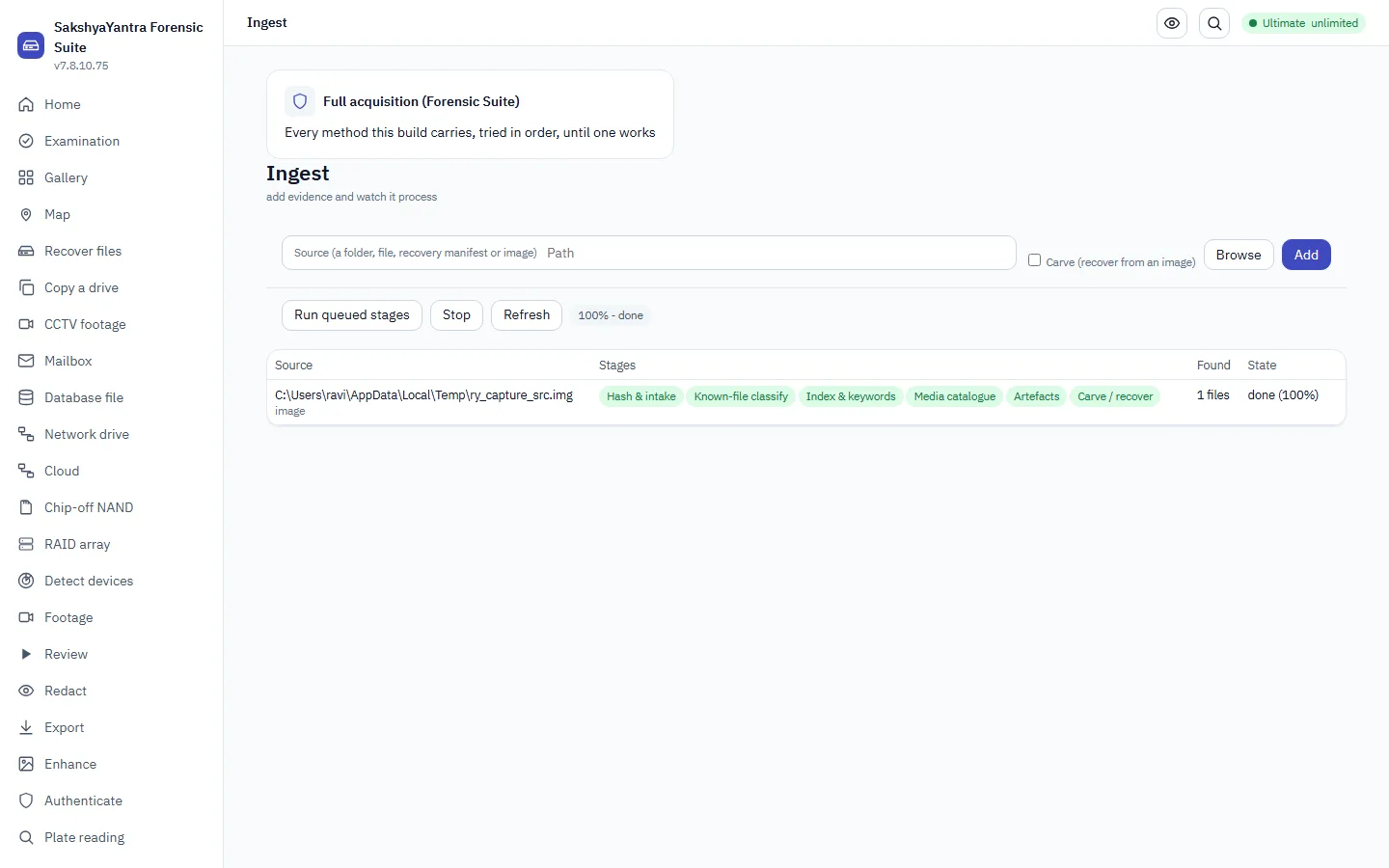
Add a folder, file, recovery manifest or image and it runs the ordinary pipeline - hash, known-file classify, index, gallery, artefacts, and an opt-in carve - with a live dashboard per item.
- Add the evidence
A stage set is queued for it at once; carve is opt-in and only meaningful for an image.
- Run the pipeline
Each stage is isolated - one failing does not stop the others - and retryable; a resumed case skips finished stages.
- Watch the dashboard
Per-stage status, progress and counts, and the case's overall progress.
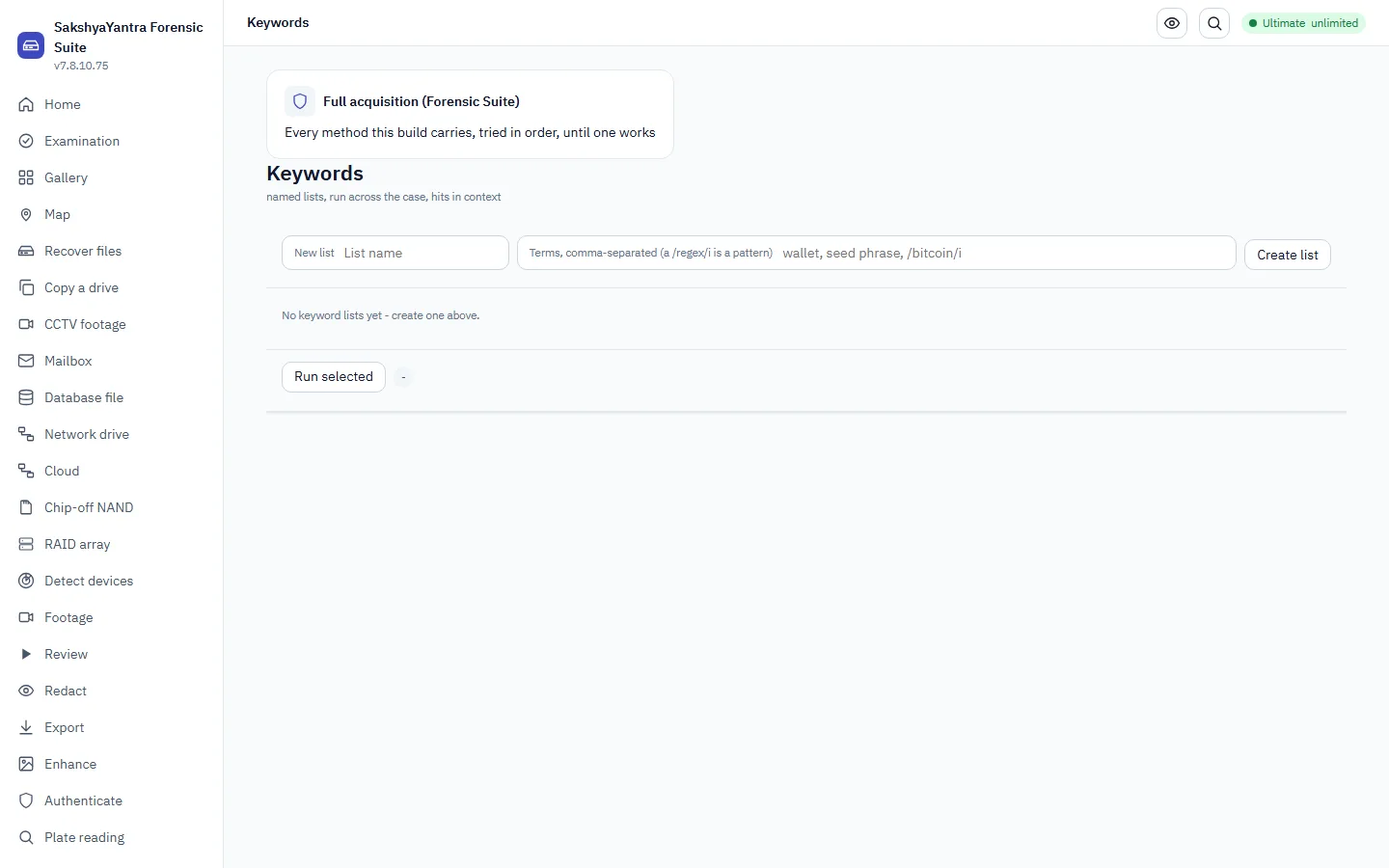
Build named keyword or regex lists, run them across the case's indexed text, and review each hit with its highlighted context.
- Build a list
Literal terms or /regex/ patterns, case-sensitive or not, saved with the case.
- Run it across the case
Every indexed item is searched; a hit carries its keyword, source item, character offset and surrounding context.
- Mark a hit
Tag a hit or add it to a finding through the case's own door.
ISO/IEC 27037 7.6 - documentation
Build an entity/connections graph over the case's contacts, messages, calls, mail and browser history, and read it as a graph - never a guessed relationship, only what those parsers already found.
- Build the graph
Entities (devices, people, phones, emails, accounts, domains) and edges (sms/call/chat/email/contact/visit), each with its own provenance.
- Explore it
Degree, betweenness and community metrics; the shortest path between two entities; one entity's neighbourhood.
- Bookmark an entity or a connection
Recorded as a finding through the case's own door.
ISO/IEC 27037 7.6 - documentation
Validated enhancement families, run as a recipe whose parameters are pinned, with the original kept beside the result and the chain printed beneath.
- Choose the frames
A frame pack or a folder of PNGs. The lab never opens the video itself; it works on frames whose digests it records.
- Pick or save a recipe
A chain of validated operators with its parameters pinned. A pin that no longer matches this build refuses to run rather than doing something else quietly.
SWGDE Best Practices for Image and Video Enhancement - documented, repeatable processing.
- Run it and keep bothsafety - cannot skip
The enhanced frame is shown beside the original, never instead of it; both are exported with the chain.
ISO/IEC 27042 s7 - reproducibility of processing.
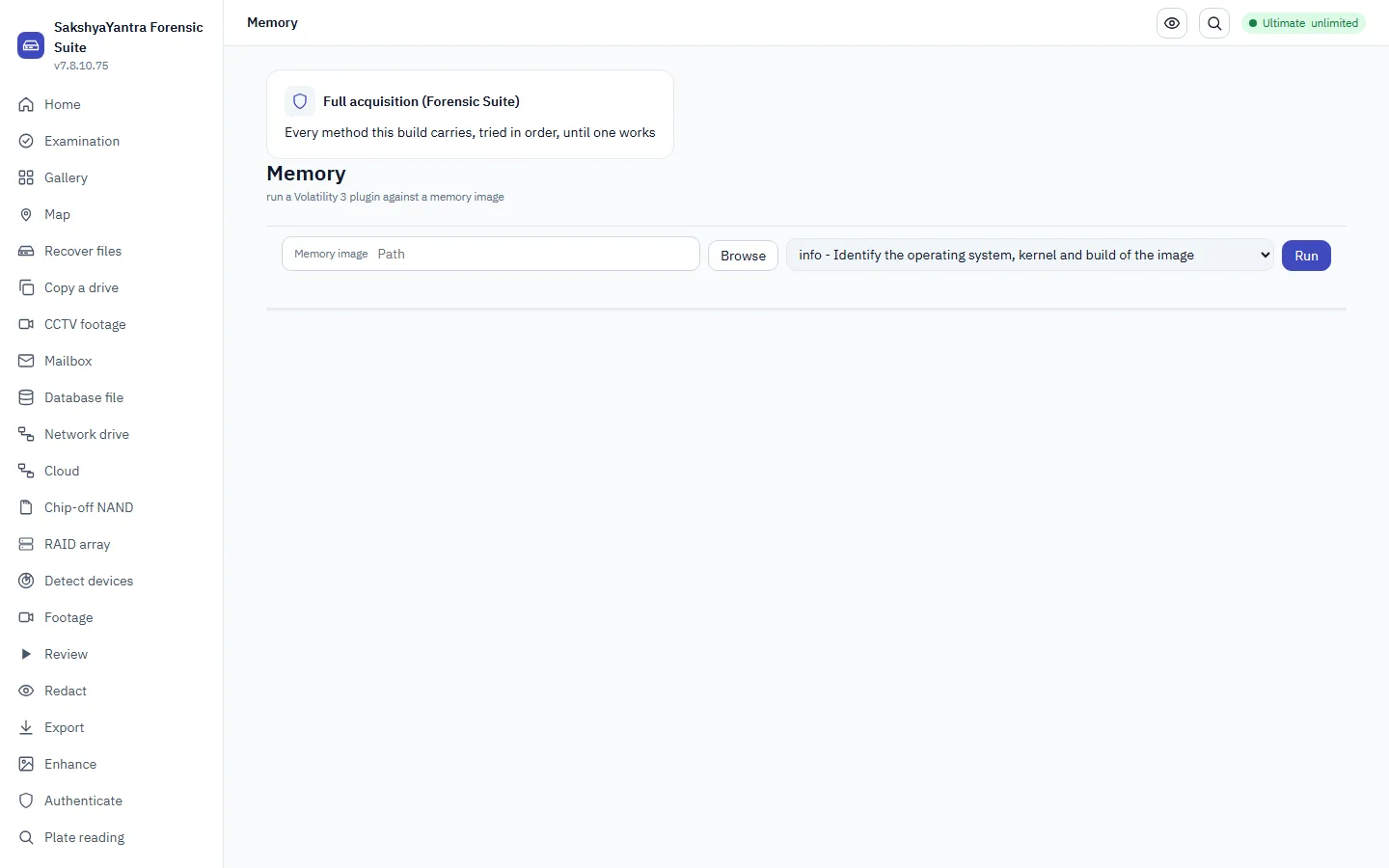
Run a Volatility 3 plugin - processes, network, DLLs, handles, malware detection - against a memory image and read the result as a table.
- Pick a plugin
Processes, process tree, command lines, network connections, loaded DLLs, open handles, or a malware-detection plugin, for Windows, Linux or macOS.
- Run it
Offline by default; an honest refusal names what is missing (no image, Volatility 3 absent, symbols unavailable) rather than guessing.
- Add a row to a finding
The exact row, the plugin and the Volatility 3 version travel with it.
ISO/IEC 27037 7.6 - documentation
mobilefull
In SakshyaYantra Forensic Suite, SakshyaYantra Mobile Workbench, RecoverYantra Mobile
Where consent-based copying cannot reach the data, this works down every physical/file-system method this build carries - in order - and stops at the first that works. A forensic act: recorded, and only in a build the forensic family was given it in.
- Describe the device
What it answers with, or a picked class - nothing is assumed about a device this build has not identified. Reachability is checked before anything is tried.
ISO/IEC 27037 7.4 - identification of digital devices.
- Read the ranked plan
Every method this build carries for this device, ranked, with the honest gap named when none can reach it.
- Record the operator's lawful authoritysafety - cannot skip
A physical/file-system acquisition is only lawful with the owner's consent or proper authority. This is recorded and cannot be skipped.
- Attempt, in order
Works down the ranked list and stops at the first method that succeeds; a failure names every method tried.
Owner's rule (CLAUDE.md, R-MOBILE-FULL) - the honesty boundary is what public exploits actually reach.
A lab that reads a bare memory chip hands you a raw dump, not a disk. This works out the page and block geometry, unscrambles the controller, applies the chip's error correction and puts the blocks back in order, then writes an image the recovery flow can open.
- Point at the raw dump
The file the lab produced, spare (OOB) areas included. It is read-only; nothing is written to it.
- Analyse first
Read the dump and report the geometry, scrambling, error correction and block map. It writes nothing and tells you which figures, if any, the lab still needs to supply.
- Where should the image be saved?safety - cannot skip
A separate drive from the dump.
- Rebuild the image
Write the image, and read the count of pages the error correction could not fully fix before trusting it - a complete image is not the same as a fully verified one.
A model may be asked what a plate says - after the examiner has sealed their own reading, and only as an AI observation that a typed reviewer decision can later promote.
- Prepare the frame packsafety - cannot skip
Only a frame pack ever leaves the machine, and only in the mode the agency has switched on: none, a local model pack, or a cloud provider behind the authorisation switch. Reachability is checked before any key is touched.
Owner's rule (CLAUDE.md, SakshyaYantra video rules) - the frame pack is the only unit that leaves the machine.
- Seal your own readingsafety - cannot skip
What you read, sealed with a digest before the model is asked. The order cannot be reversed: the reveal is refused until the seal exists.
Owner's rule - the examiner's reading is sealed BEFORE any AI answer is shown.
- Read the AI observation
Model, version, prompt, input digests, time and the verbatim text - labelled an observation, never a finding, and the transfer manifest lists every digest that left.
Owner's rule - an AI response is an observation, promoted only by a typed reviewer decision.
A RAID set is spread across several disks. Add each member (or a missing one, blank), let it work out the layout off the disks - Windows dynamic disks, Intel RST, SNIA DDF, Synology SHR / mdadm - or set the level yourself, check the assembled volume's partition table looks right, then recover from it exactly like a single disk.
- Add the members
Each disk or image in the set. They are only ever read, never written. A RAID 5 array still rebuilds with one member missing (RAID 6 with two) - mark a missing member's row blank so the array is rebuilt degraded.
- Work out the layout
Read the RAID metadata off the disks (LDM, IMSM, DDF, SHR / mdadm), or set the level, chunk size and layout yourself when there is no metadata to read.
- Check the assembled volume
See the rebuilt volume's partition table before committing. If it looks wrong, go back and set the level yourself rather than recovering from a bad assembly.
- Recover from the array
Hand the assembled volume to the ordinary recovery scan - the same results grid and export, licensed and charged like any single source.
We publish a registry, not a 'hundreds of formats' claim: a format is listed only when a real sample decoded a frame. This screen shows that proven coverage, the signed recorder registry, and the specimens we hold but cannot yet decode - and lets you send a new sample, offline and consent-gated, so breadth grows one proven specimen at a time.
- Read the proven coverage
The count of (container, codec) pairs that decoded a frame from a REAL sample - the number we can prove, never a claimed total.
- Read the recorder registry
The signed make / model rows, each proved by a specimen; when there is none it says why, never a blank.
- See what is not yet supported
Real specimens we hold but cannot yet prove a decoded frame from - the honest gap, never dressed up as support.
- Send a sample for support
Offline and consent-gated: only the first 1 MB and the hash leave the file - never a frame, never case data, no transport - so a new recorder can be worked on next build.
A mask over a region of frames, a named person's typed decision, and an export that is refused until that decision says approve.
- Mask the region
Pixels in the frame, from one frame to another; optionally followed across frames. The original is never written to; the mask is a record with its own chain.
SWGDE Best Practices for Forensic Video Analysis s9 - processing recorded and repeatable.
- A named reviewer decidessafety - cannot skip
Approve or reject, typed with a name and a note. The decision goes into the hash-chained audit trail and the report. Recorded by the software, not authenticated by an account system - and said so.
ACPO principle 3 - a record of all processes, and who applied them.
- Export the redacted copysafety - cannot skip
Refused until an approve decision exists. The copy carries the mask chain and its hashes; the original stays as it was.
ISO/IEC 27042 s8 - a derived item names what it was derived from.
Playback that lands on the frame you asked for, with the three clocks kept apart, and a frame pack as the only thing that leaves the machine.
- Open the asset
The frame server reads the index first: frame count, keyframes, gaps and field steps are reported before a picture is drawn, and none is interpolated.
SWGDE Best Practices for Forensic Video Analysis s6.2 - frame-accurate access.
- Step through the frames
Presentation ticks, the decoded index and the recorder's overlay text are three fields and are never merged into one time. Bookmark what you see in your own words.
SWGDE s6.3 - timing recorded per frame; the recorder clock is text, not truth.
- Capture a frame packsafety - cannot skip
A few frames as PNG, each with its times, its source id, hash and extent and its own SHA-256, plus a hashed manifest. Never the video. Verify it before it leaves.
ISO/IEC 27042 s8 - derived items hashed and traceable to the original.
Examine an image or file for concealed data - bytes appended after its end, a whole file embedded inside it, a known stego tool's signature, or a payload hidden in the pixels' least significant bits - then carve out what is found. The exhibit is read only and never changed.
- Choose the file to examine
Point at the exhibit - a photo, a scan, an audio file or any file a payload might be hidden in. It is opened read only.
ISO/IEC 27037 7.5 - collection and preservation
- Run the examination
The battery checks for appended data, embedded files, known stego-tool signatures and LSB payloads (chi-square for sequential embedding, RS analysis for a payload estimate). Each step is shown as it runs.
- Recover what was found
Where something is found, carve it out to a folder you pick. A carve is confirmed only when identifiable bytes come back; anything uncertain is labelled so, never overstated.
- Read the verdict and the limit
The verdict is graded clean, likely or confirmed, with the methods used and the honest limit: content-adaptive schemes need a trained model pack, which the tool says is not installed rather than missing silently.
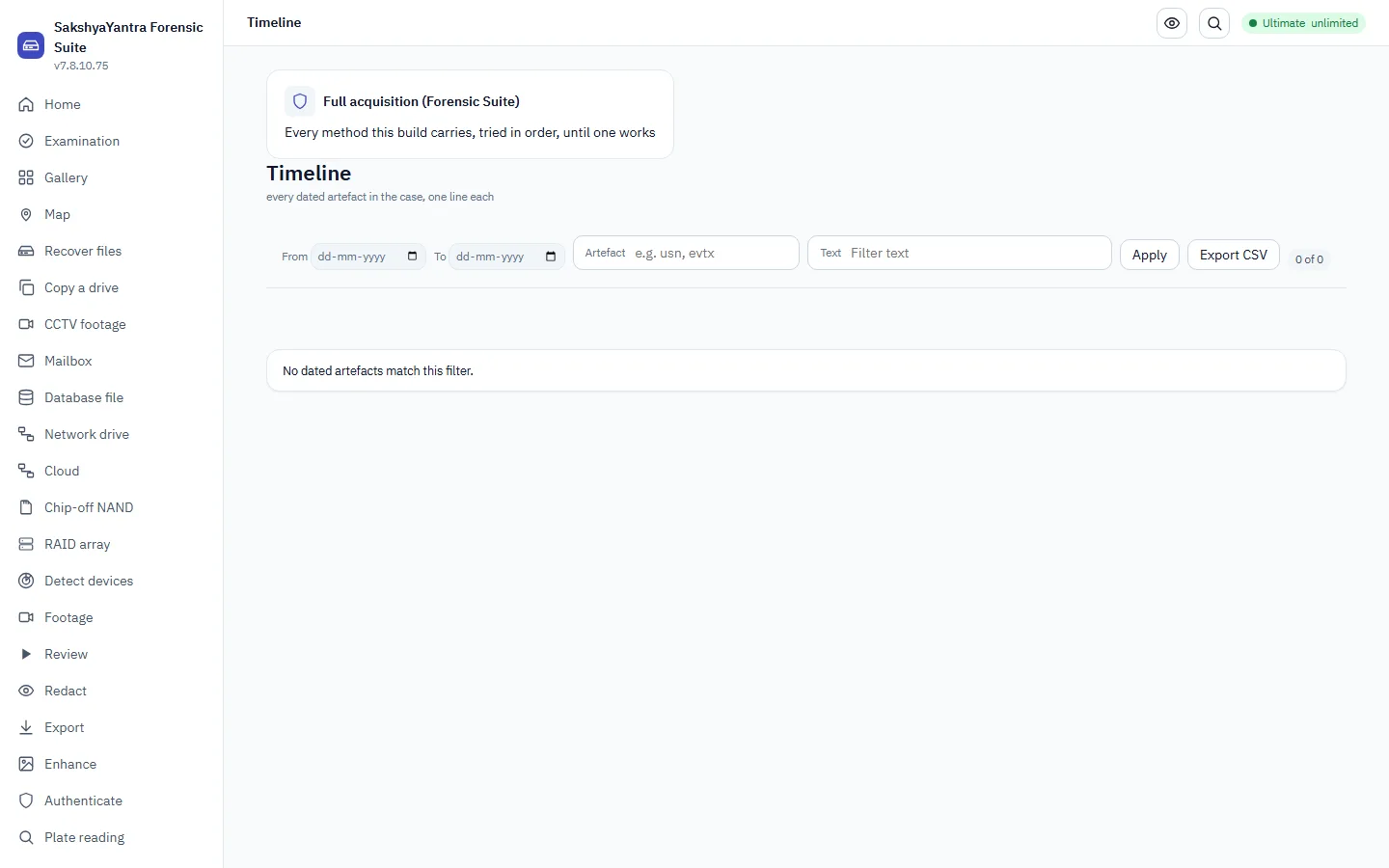
Every dated artefact the case's exhibits carry - one line each, filterable by date, artefact, source or text, with a zoomable histogram.
- See the shape of the case
The histogram buckets events by day (or another grain); an empty bucket is absent, never invented.
- Narrow it down
By date range, artefact type, source exhibit or free text.
- Mark an event
Tag it or add it to a finding through the case's own door.
- Export it
log2timeline/Timesketch CSV (l2tcsv) or JSON.
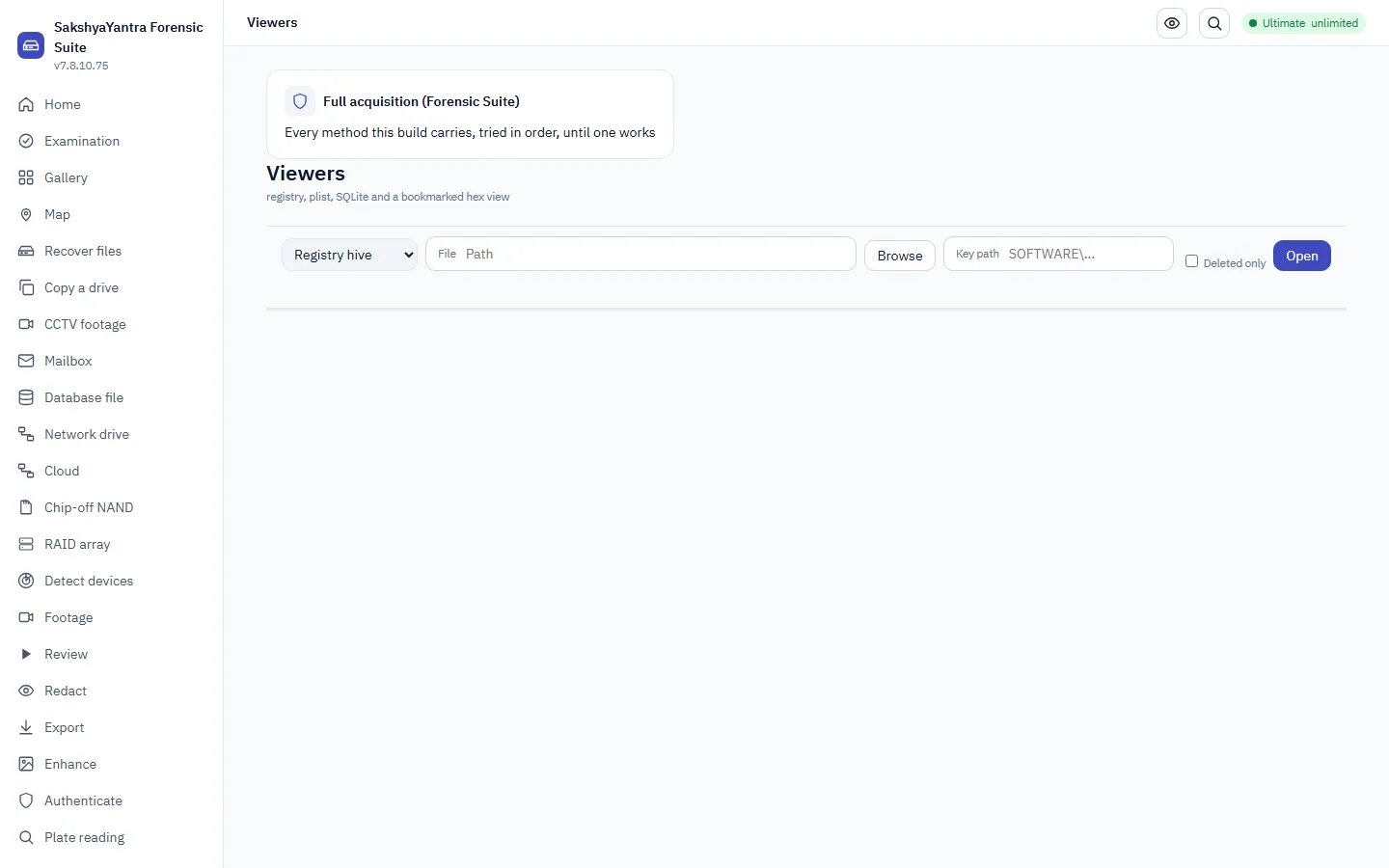
Walk a registry hive's keys and values, a property list's tree, or a SQLite database's tables and rows - or read any file as bookmarked hex.
- Pick a viewer and a file
Registry hive, plist, SQLite database, or hex - deleted keys/values and deleted/superseded rows are a switch away.
- Walk the structure
Subkeys and values with types; tables with schema and row counts, then a page of rows; a paged hex window with typed data interpretation.
- Bookmark a byte range
The bytes (up to 256) and their SHA-256 are captured, so a later reader can prove the mark still points at what the examiner saw.
ISO/IEC 27037 7.6 - documentation
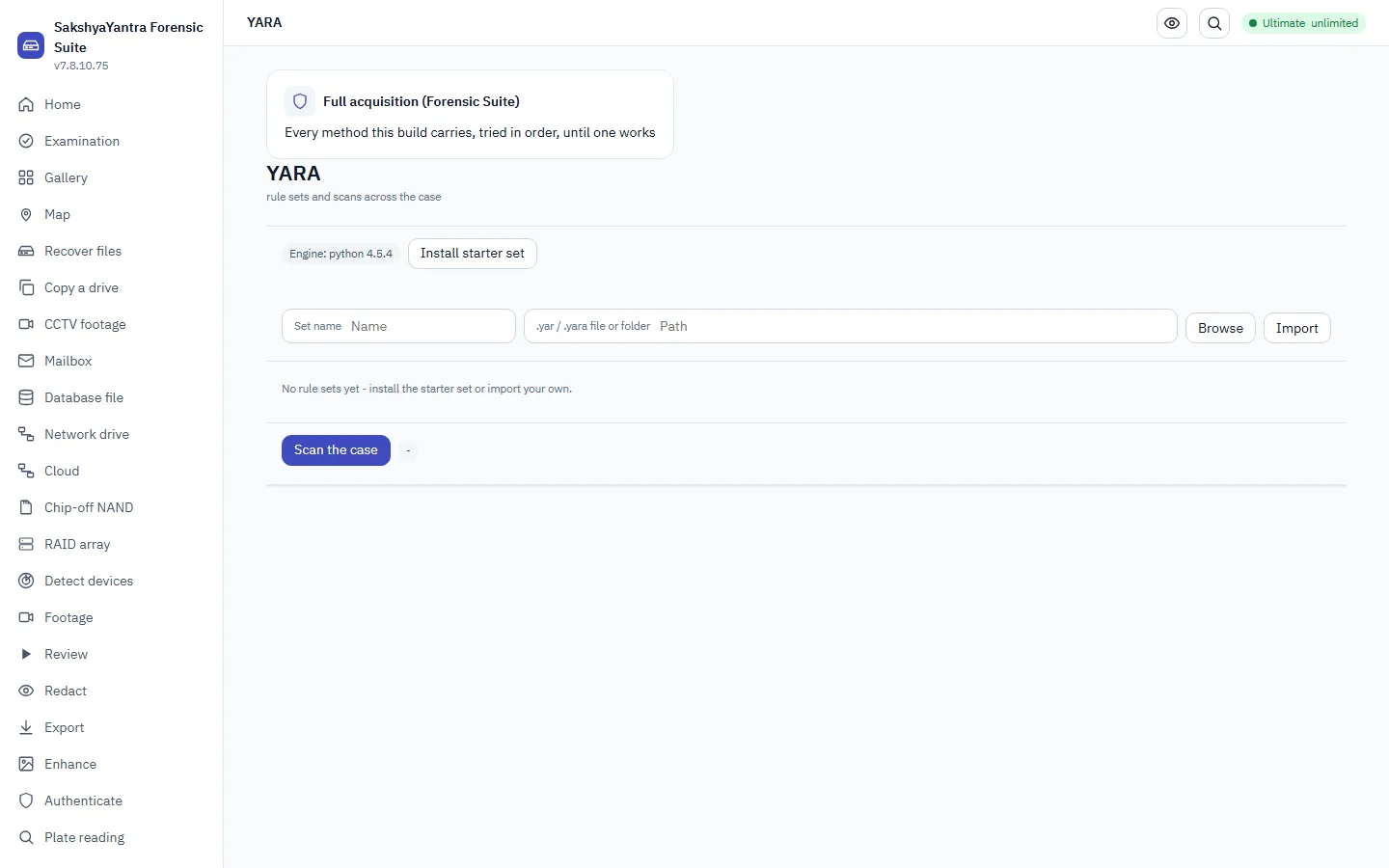
Manage named rule sets - a bundled benign starter, or your own .yar files - and scan the case's evidence with the enabled ones.
- Install or import rule sets
The bundled starter set (PEM key / PE / email / demo marker, no malware signatures), or your own .yar file or folder - a bad rule is reported, the rest of the set still saves.
- Scan the case
Runs the enabled sets over the case's evidence with the real YARA engine (yara-python or the yara tool) - never a hand-rolled matcher.
- Mark a hit
Tag a hit or add it to a finding, with the matched rule, set and offset.
ISO/IEC 27037 7.6 - documentation